Skip to content
اردو
CRD: Card Games

Mus

CardMultiplayerHard~20 min

Ready to play · free

Jugar al mus online free: bet, bluff and signal your partner through Grande, Chica, Pares and Juego with the Spanish deck, then call órdago.

Play now4 players · vs computer or friends

Rate this game

Be one of the first to rate it.

Game info

Developer
PlayNest Studio
Released
Last updated
Platforms
Browser, Android, iPhone, PC
Players
4 players, vs computer or friends
Average play time
~20 min per round
Languages
English, Urdu
Controls
Keyboard or mouse on computers, touch on phones and tablets
01

How to play

  1. You and your partner (top of the table) play against the other pair. Four cards each; the mano speaks first and wins ties.
  2. Say Mus to change one to four cards, or No hay mus to start the betting with the cards you hold.
  3. Four lances in order: Grande (highest cards), Chica (lowest), Pares (pairs) and Juego (31 or more), or Punto if nobody has juego.
  4. In each lance pass, bet (envido) or call órdago; the other pair answers quiero, no quiero or raises.
  5. Cards are shown at the end and piedras counted in lance order. First pair to 40 piedras wins the game.
02

Controls

Keyboard & mouse

Click
Pick cards to discard, say Mus or place a bet
TabEnter
Move between buttons and press one
Esc
Open the game menu

Touch

Tap
Pick cards, bet or send a seña
03

About

Mus, the Basque and Spanish partnership game: four players, two pairs, partners opposite, four cards each from the 40-card Spanish deck. Nobody plays tricks. Instead you bet on four lances, Grande, Chica, Pares and Juego, bluff, signal your partner with señas and stake the whole game on an órdago. First pair to 40 piedras wins.Also known as Mus, Mus online, Jugar al mus, Jugar al mus online, Jugar al mus online gratis, Mus gratis, Mus online gratis, Mus online gratis con amigos, Mus con amigos, Mus contra la máquina, Juego del mus, Reglas del mus, Señas del mus, Senas del mus, Mus a 8 reyes, Mus a 4 reyes, Mus por parejas, Mus vasco, Mus órdago, Mus ordago, Partida de mus, Mus sin registro, Mus card game, Spanish card game Mus, Basque card game Mus, Mus juego de cartas.

04

Tips & tricks

  • Ties go to the player closest to the mano, so the mano can bet hands that would only tie.
  • Check your partner's señas before you bet: dos reyes makes a Grande bet much safer.
  • Save the órdago for when the opponents are close to winning or your hand cannot lose.

Mus: complete guide

Mus is the Spanish partnership card game of betting, bluffing and secret signals, born in the Basque Country and Navarre and now played in bars and family kitchens all over Spain. Here you can jugar al mus online, free in your browser, with the 40-card Spanish deck, the four lances, envites, órdago and the señas. Play against the computer on three levels, or open a room and send friends a link so your partner sits across the table.

How to play Mus

Mus is played by four people in two pairs, partners sitting opposite. Nobody plays tricks. Each hand is a series of four contests, called lances, and in each one the pairs bet on who holds the better cards. You win by being right, or by making the other pair believe you are. The first pair to 40 piedras (or 30, if you choose) wins the game.

A hand runs like this:

  • Each player gets four cards. The player to the dealer's right is the mano: they speak first and win every tie. Play goes counter-clockwise, to the right, as in Spain, and the mano moves one seat each hand.
  • The mus phase: starting with the mano, each player says Mus (I want to change cards) or No hay mus (I keep these). If all four say Mus, everyone discards one to four cards, draws replacements, and the round starts again.
  • As soon as anyone says No hay mus, the lances begin with the cards everyone holds.
  • The four lances are played in order: Grande, Chica, Pares and Juego (or Punto if nobody has juego). In each one the pairs can pass, bet or go all in with an órdago.
  • At the end the cards are shown and the piedras are counted in the same order. Then a new hand is dealt.

Mus rules for beginners: the deck and card values

Mus uses the 40-card Spanish deck, the baraja española, with four suits: Oros (coins), Copas (cups), Espadas (swords) and Bastos (clubs). Each suit runs As, 2 to 7, Sota, Caballo and Rey. Suits never matter in Mus, only ranks.

In the usual game, played a 8 reyes, every 3 counts as a Rey and every 2 as an As, so the deck holds eight kings and eight aces. From high to low the ranking is Rey (and 3), Caballo, Sota, 7, 6, 5, 4, As (and 2).

For Juego each card has a point value: Rey, Caballo and Sota count 10, other cards their face value. Playing a 8 reyes, a 3 counts 10 and a 2 counts 1.

A toggle switches our cards to a French-suited deck (Oros as Diamonds, Sota as Jack and so on) with the same rules.

Mus or no hay mus: changing your cards

Before any betting, the table decides whether to change cards. If even one player says No hay mus, the lances start at once. When all four say Mus, each player discards between one and four cards and draws the same number, and this repeats while everyone keeps saying Mus. If the deck runs out, the discards are reshuffled.

A player who cuts the mus is usually happy with something, so take note.

The four lances: Grande, Chica, Pares and Juego

**Grande** is won by the highest hand. Compare each hand's best card first, then the second best, and so on. Four Reyes is the strongest Grande hand.

**Chica** is the opposite: the lowest hand wins, and four Ases (with 8 reyes, any mix of Ases and 2s) is the best.

**Pares** is about matching ranks. A par (two of a rank) is worth 1 piedra, medias (three of a kind) 2, and duples (two pairs, or four of a kind) 3. Duples beat medias, medias beat a par, and within the same kind higher cards win. Every player first says whether they have pares. Betting only happens if both pairs have them; if only one side does, it scores them without betting, and if nobody has pares the lance is skipped.

**Juego** is about the total of your four cards. A total of 31 or more is juego, ranked in an unusual order: 31 is best, then 32, 40, 37, 36, 35, 34 and 33. A juego of 31 is worth 3 piedras, any other 2. Players declare juego just as they do pares.

**Punto** replaces Juego when nobody has juego: the highest total of 30 or less wins, worth 1 piedra on top of any bet.

In every lance, ties go to the player closest to the mano, which makes being mano a real advantage.

Envites: envido, quiero, no quiero

Each lance has its own betting, the envites. Starting from the mano, a player can say Paso (pass), Envido (2 piedras), Envido 5, or Órdago (the whole game). If someone bets, either partner of the other pair may answer:

  • **Quiero**: the bet is accepted and paid at the end of the hand, when the cards are shown.
  • **No quiero**: the bet is refused and the bettors collect at once: 1 piedra for a first bet, or the amount already accepted if there were raises. This is the deje.
  • **Raise**: answer with 2 more or 5 more, and the bet goes back to the other side.
  • **Órdago**: answer any bet, or open, with the whole game.
  • **En paso**: if everybody passes, the best hand still wins the lance. Grande and Chica are then worth 1 piedra at the end.

What is the órdago in Mus?

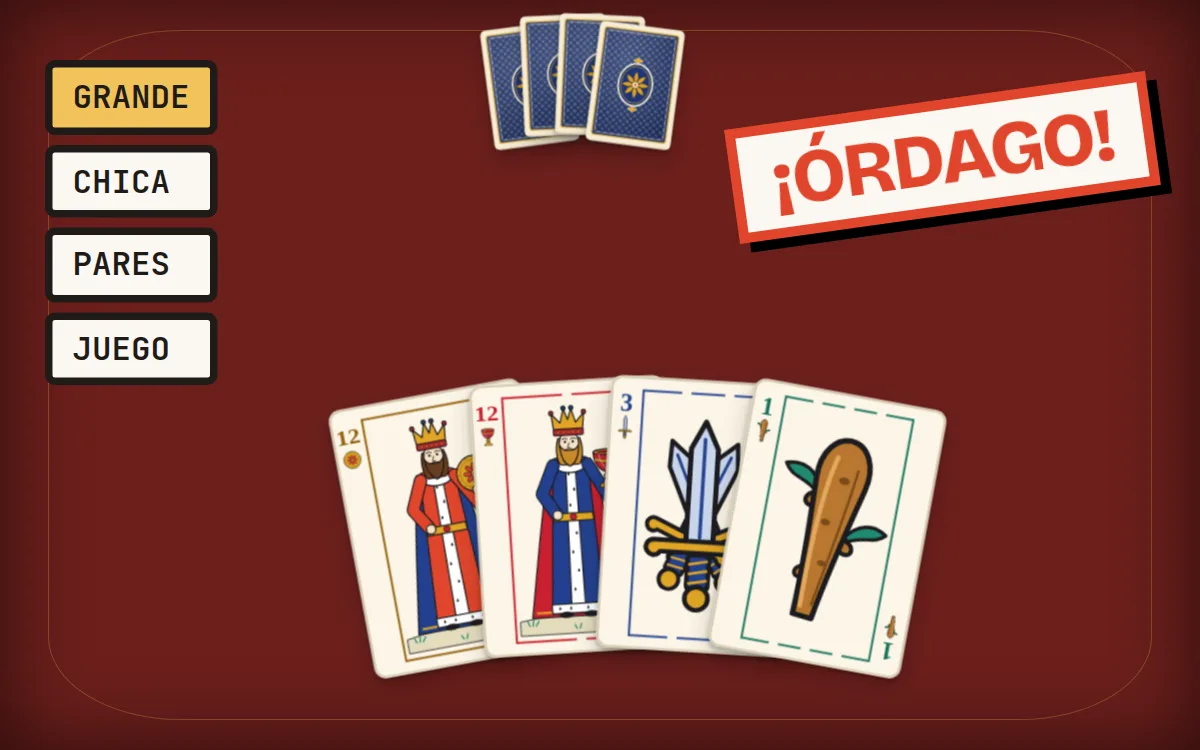
The órdago is the all-in bet: it puts the entire game on one lance. If the other pair refuses, the bettors collect the deje. If they accept, the cards are shown at once and the winner of that lance wins the game, whatever the score.

The word is usually traced to the Basque hor dago, roughly there it is. A good player saves the órdago for when it changes the result: when the opponents are close to winning, or when a hand is close to unbeatable. Our computer players use it rarely and sensibly.

Señas del mus: the partner signals

Mus is one of the few card games where signalling to your partner is part of the rules. The señas are small faces that tell your partner what you hold, allowed as long as everyone uses the agreed ones. The skill is to signal when the opponents are not looking. These are the common señas our help panel teaches:

  • Dos reyes: bite your lower lip.
  • Tres reyes: bite your upper lip.
  • Dos ases (pitos): tip of the tongue out in the middle.
  • Tres ases: tongue out to one side.
  • Duples: raise your eyebrows.
  • Medias: twist your mouth to one side.
  • Juego de 31 (la una): wink.
  • Ciego (no pares, no juego): close both eyes.

8 reyes or 4 reyes?

Mus a 8 reyes is the most common way to play in most of Spain and it is our default. With eight Reyes and eight Ases, hands with two or three kings come up often and Grande and Chica are hotly contested. Mus a 4 reyes treats every card as itself, so the 3 and 2 are ordinary low cards and strong Grande hands are rarer. Some groups and regions prefer it, and you can pick either in the settings.

Mus scoring: piedras, amarracos, juegos and vacas

Points in Mus are piedras (stones), traditionally counted with small stones or beans. Five piedras make an amarraco, and the scoreboard shows both. A juego, one game, goes to the first pair to reach 40 piedras, or 30 if you set a shorter game.

Refused bets are paid at once. Everything else is counted at the end of the hand in a fixed order: Grande, Chica, Pares, then Juego or Punto. Each lance's winner takes any accepted bet, and the winners of Pares and Juego also collect the value of their own pair's pares and juego (Punto adds 1). Counting stops the moment a pair reaches the target.

Choose the length: a single game, a vaca (best of three games, our default) or a partida (best of three vacas).

Mus strategy and tips

Mus rewards reading people more than holding perfect cards. These habits help from your first hand:

  • Remember the counting order. Grande is counted first, so near the end of a game a small Grande win can finish it.
  • Value being mano: ties are yours, so you can bet with hands that would only tie.
  • Use the public declarations. When everyone says whether they have pares and juego, you learn a lot about four hidden hands.
  • Check your partner's señas before you bet. A partner with dos reyes makes your Grande bet much safer.
  • Do not chase every lance. Passing Grande and Chica with a middling hand and saving your strength for Pares or Juego is often right.
  • Bluff with a plan: a bet with weak cards works best after the opponents have shown weakness.

Play Mus online with friends or against the computer

To play alone, choose Play vs computer and pick Easy, Normal or Hard. Each computer estimates its chances in every lance from its cards, its partner's señas and the pares and juego declarations, with the score in mind. Normal and Hard bluff a little. Señas are on by default: your computer partner signals with a small face animation and its meaning, reads the señas you send from the panel, and now and then you catch an opponent's seña.

To play Mus online with friends, open a room and share the link (there is a WhatsApp button) or the 6-character room code. Computers fill any empty seats, so two, three or four people can play. Rooms have chat with emojis and quick phrases, plus optional voice chat. There is no quick match with strangers: you play with the people you invite.

It runs in the browser on phone, tablet or computer, with no download and no sign-up, and keeps your statistics, streaks and achievements.

Where Mus comes from: the Basque Country and Navarre

Mus comes from the Basque Country and Navarre, where it has been played for centuries, and spread from there across Spain. Basque emigrants took it to France and the Americas, so there are mus tables in Argentina, Uruguay, Mexico and other countries with Basque communities. Today it is played in bars, at village festivals and in organised tournaments, and every region keeps its own small customs.

En español: jugar al mus online gratis

En PlayNest puedes jugar al mus online gratis, en el navegador y sin registro. Juega contra la máquina en tres niveles o crea una sala y comparte el enlace para jugar al mus con amigos por parejas. Se juega con la baraja española de 40 cartas, a 8 reyes o a 4 reyes, con los cuatro lances (grande, chica, pares y juego), envites, órdago y señas. Puedes jugar a un juego, a una vaca o a una partida completa, a 30 o a 40 piedras.

05

Mus FAQ

Is Mus free to play?
Yes. Mus is completely free on PlayNest. There is nothing to buy and no account to create.
Do I need to download Mus?
No. Mus runs in your web browser, so you can start playing straight away on Chrome, Safari, Edge or Firefox.
Can I play Mus on my phone?
Yes. Mus works on Android phones, iPhones, tablets and computers, with touch and keyboard controls.
How many players can play Mus?
You can play against the computer, or create a room and share the link to play Mus online with friends.
How long does a game of Mus take?
A round takes about 20 minutes. It is rated hard and sits in our Card Games collection.
How many cards are used in Mus?
Mus uses 40 cards: the Spanish deck without 8s and 9s, with As, 2 to 7, Sota, Caballo and Rey in four suits. Each player gets four cards and, when everyone says Mus, can change one to four of them. Suits never matter, only ranks and point values.
How many players do you need for Mus?
Four players in two pairs, partners sitting opposite. In our game the computer fills any seat a person does not take, so you can play alone with three computer players, or with one, two or three friends in an online room.
What is órdago in Mus?
Órdago is the all-in bet that stakes the whole game on a single lance. If the other pair says no quiero, the bettors collect the deje. If they say quiero, the cards are shown at once and the winner of that lance wins the game, whatever the score was.
What does 31 mean in Mus?
31 is the best juego, the best possible total in the Juego lance. Figures count 10 and other cards their face value, and any total of 31 or more is juego. 31 beats 32, then 40, 37, 36, 35, 34 and 33, and is worth 3 piedras instead of 2.
What are señas in Mus?
Señas are the agreed facial signals partners use to tell each other what they hold, and they are a legal part of Mus. Biting your lower lip shows two Reyes, a wink shows a juego of 31, and closing both eyes shows ciego. Our help panel lists the common señas.
Can you talk in Mus?
Not about your cards. At a traditional table you speak only to make or answer bets, and the señas are the one allowed way to tell your partner what you hold. Some tables play without señas at all. Our online rooms have chat and voice, so agree with friends how you want to play.
What is the difference between Mus a 8 reyes and 4 reyes?
With 8 reyes, every 3 counts as a Rey and every 2 as an As, so the deck has eight of each and strong Grande and Chica hands are common. With 4 reyes every card is itself. 8 reyes is the most common in most of Spain and our default.
How many piedras do you need to win a game of Mus?
A game of Mus, called a juego, is usually played to 40 piedras, our default, or 30 for a shorter game. Five piedras make an amarraco. Counting stops the moment one pair reaches the target, even halfway through the end-of-hand count.
What is a vaca in Mus?
A vaca is won by the first pair to take two games, so it is the best of three. A partida is the best of three vacas. In our game you can play a single game, a vaca, which is the default, or a whole partida when you have more time.
Who is the mano in Mus?
The mano is the player to the dealer's right. The mano speaks first in the mus phase and in every lance, and wins every tie, which is a real advantage. Because play goes counter-clockwise, the mano moves one seat to the right with each new hand.
What are pares, medias and duples?
They are the three kinds of hand in the Pares lance. A par is two cards of the same rank, worth 1 piedra. Medias are three of a kind, worth 2. Duples are two pairs or four of a kind, worth 3, and beat medias, which beat a single par.
What does no quiero mean in Mus?
No quiero means you refuse the bet. The betting pair collects straight away: 1 piedra if it was the first bet in the lance, or the amount already accepted if there had been raises, which is called the deje. Pares and juego values are still paid at the end.
06

You might also like

More Card Games