Skip to content
اردو
PZL: Puzzle & Brain

Memory Match

PuzzleSoloEasy~3 min

Ready to play · free

Flip two cards at a time and find every pair. Four grid sizes, two-player turns and a daily layout.

01

How to play

  1. Tap any card to turn it over, then tap a second card.
  2. Matching pictures stay face up. Different ones flip back after a moment, or tap anywhere to flip them back sooner.
  3. Two flips make one move. Find every pair in as few moves as you can.
  4. Stars depend on moves only: three stars for up to one and a half times the number of pairs.
02

Controls

Keyboard & mouse

Click
Flip a card
←↑→↓
Move between cards
EnterSpace
Flip the focused card
R
Restart with a new shuffle
PEsc
Pause

Touch

Tap a card
Flip it
Tap anywhere
Turn a missed pair back early
03

About

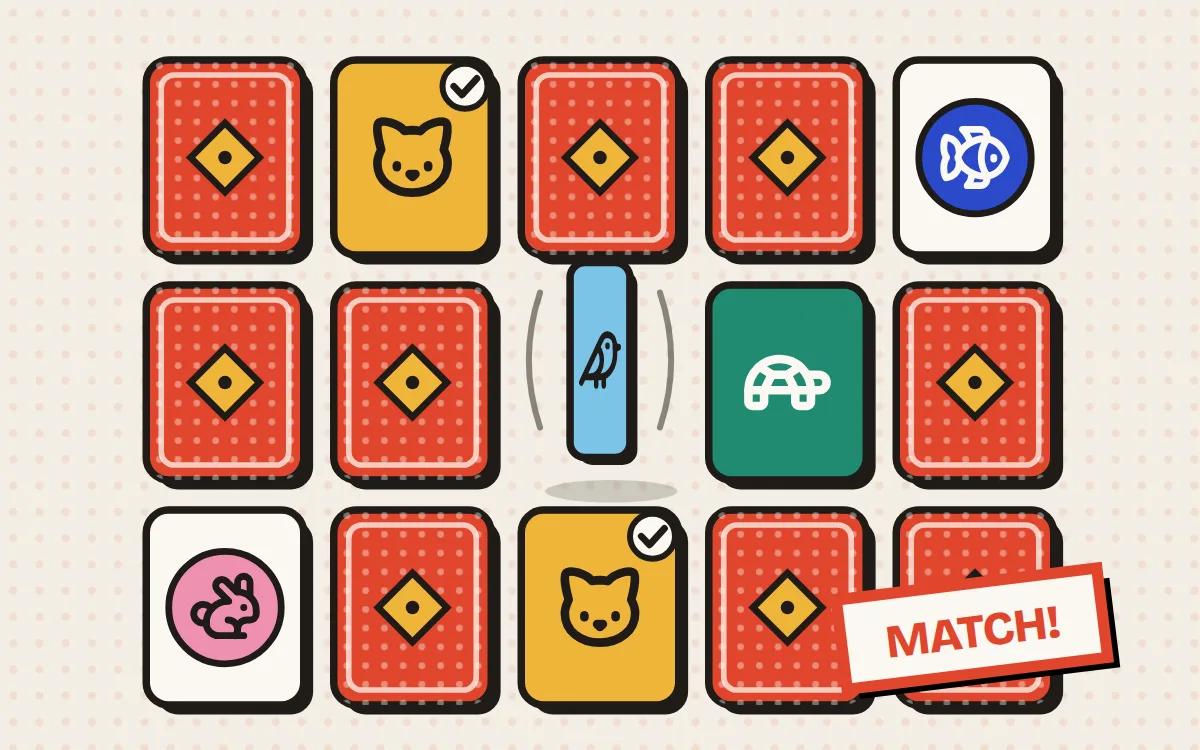
A grid of riso-printed cards lies face down. Flip two at a time, remember what you see, and find every matching pair in as few moves as you can. Four grid sizes, three card sets, a two-player mode for one device and a new daily layout every day.Also known as Concentration, Pairs, Match Up, Pelmanism, Memory card game, Matching pairs game, Flip cards game, Shinkei-suijaku.

04

Tips & tricks

  • If you have already seen your first card's partner, flip it straight away.
  • Never spend your second flip on a card you know cannot match. Turn over a new one instead.
  • Name pictures with their place, like cat top left. Words stick better than images.

Memory Match: complete guide

Memory Match is the classic card game of Concentration: a grid of cards lies face down, you turn over two at a time, and you try to remember where every picture is hiding. Play it free in your browser, alone against your best score, with a friend on the same device, or on the daily puzzle that everyone shares.

How to play Memory Match

Every card has a twin somewhere in the grid. At the start all cards are face down, showing the same red printed back. Your goal is to find every pair.

  • Tap or click any card to turn it over.
  • Turn over a second card. If both pictures are the same, the pair stays face up and gets a small tick.
  • If they are different, both cards stay visible for a moment so you can memorise them, then flip back over. Tap anywhere to flip them back sooner.
  • Two flips make one move. Keep going until every pair is face up.

Grid sizes, card themes and modes

There are four grids. Easy is 4 by 3 with 6 pairs, Medium is 4 by 4 with 8 pairs, Hard is 6 by 4 with 12 pairs, and Expert is 6 by 6 with 18 pairs. On a phone held upright the grid turns on its side, so a 4 by 3 board becomes 3 columns by 4 rows and the cards stay as big as possible.

Pick from three card sets: Animals, Food, or Toys and sport. Every pair has its own picture and its own colour, so you never have to tell two similar shades apart. Half the pairs are printed on a full coloured card and half sit on a coloured disc on white paper, which helps the colours stay distinct too.

Solo is you against the clock and your own record. Two players is for sharing one phone or laptop: players take turns, finding a pair scores a point and earns another go, and a miss passes the turn. The player with more pairs at the end wins, and an even split is a draw. Daily gives everyone the same Medium layout and card set for the day, and marks the daily challenge as done when you finish.

Moves, stars and the timer

Your score is the number of moves. With perfect luck a board takes exactly as many moves as it has pairs, so 8 moves is the absolute best on Medium. Stars are based on moves only.

  • Three stars: up to one and a half times the number of pairs. That is 9 moves on Easy, 12 on Medium, 18 on Hard and 27 on Expert.
  • Two stars: up to two and a quarter times the pairs. That is 14 on Easy, 18 on Medium, 27 on Hard and 41 on Expert.
  • One star: any finish above that.

Timer, best scores and pausing

The clock starts on your first flip and is shown for fun, but it never costs you stars. On Easy it is marked as no rush, which makes the game a good fit for younger players. Your best moves, best time and best star rating are saved for each grid size in this browser. If two games tie on moves, the faster one counts as the new best.

Press P or Escape, or the pause button, to stop the clock. The cards are hidden while paused, so a break cannot be used to study the board. Switching to another tab pauses the game automatically.

Controls and accessibility

On a touch screen just tap the cards. On a computer you can use the mouse or play entirely with the keyboard: the arrow keys move between cards, Enter or Space flips the card in focus, R restarts with a fresh shuffle (the daily puzzle keeps its layout), and P or Escape pauses. Screen readers hear each card as a button, such as Card 5, face down, or Card 5, Rabbit, matched, and every flip, match and change of turn is announced. With reduced motion turned on in your system settings the cards fade instead of spinning.

Memory Match strategy that actually helps

Luck decides the first few flips, but after that a good memory system saves a lot of moves.

  • When you turn over a new first card, check whether you have already seen its partner. If you have, flip the partner and bank the pair.
  • If your first card is new and you have no idea where its twin is, make your second flip a card you have never seen. Flipping a card you already know cannot match only wastes a move.
  • Name the pictures in your head with their place, like cat top left or tea third row. Words stick better than images alone.
  • Work the board in a fixed order, row by row, so the unseen cards stay in one shrinking area.
  • Use the colours as a second clue. Remembering a blue card in the corner is easier than remembering a shape.
  • In two-player games, every miss shows your opponent two cards. Late in a game it can be better to flip a known card than reveal a fresh one they can use.

A short history of the classic

Matching games are old. In Japan, players of the 19th century were already using flower and shell cards for pair-finding games, and the version known as shinkei-suijaku, roughly nervous breakdown, is still played with ordinary cards. In Britain the game took the name Pelmanism from the Pelman memory training courses of the early 1900s, while in America it became Concentration, later the name of a long-running television quiz. Picture card versions for children became a staple of toy shops in the second half of the 20th century, and the same simple rule, two cards and a good memory, has carried over to screens almost unchanged.

05

Memory Match FAQ

Is Memory Match free to play?
Yes. Memory Match is completely free on PlayNest. There is nothing to buy and no account to create.
Do I need to download Memory Match?
No. Memory Match runs in your web browser, so you can start playing straight away on Chrome, Safari, Edge or Firefox.
Can I play Memory Match on my phone?
Yes. Memory Match works on Android phones, iPhones, tablets and computers, with touch and keyboard controls.
How many players can play Memory Match?
It is a single-player game.
How long does a game of Memory Match take?
A round takes about 3 minutes. It is rated easy and sits in our Puzzle & Brain collection.
What is the fewest moves possible in Memory Match?
One move per pair, so 6 on Easy, 8 on Medium, 12 on Hard and 18 on Expert. That needs every first guess to land on a match, so it is rare. Three stars only ask for one and a half times the pairs.
Does the timer affect my stars?
No. Stars come from your move count alone. The time is saved as a separate best and is used only to break a tie when two games take the same number of moves.
Is the daily Memory Match the same for everyone?
Yes. The daily puzzle uses today's date to build the layout and pick the card set, so every player gets the same Medium board that day. A new one appears after midnight on your device.
How does scoring work with two players?
Each pair you find is one point and gives you another turn. When you miss, the cards flip back and the other player goes. Whoever holds more pairs at the end wins, and an equal split is a draw.
Can colour-blind players play comfortably?
Yes. Every pair has a unique picture, so you can match by shape alone. Colour is an extra clue, not the only one.
Is Memory Match the same game as Concentration or Pelmanism?
Yes. Concentration, Pelmanism, Pairs and Match Up are all names for the same game of turning over two cards and remembering where each picture is.
06

You might also like

More Puzzle & Brain