Skip to content
اردو
PZL: Puzzle & Brain

Sudoku

PuzzleSoloMedium~12 min

Ready to play · free

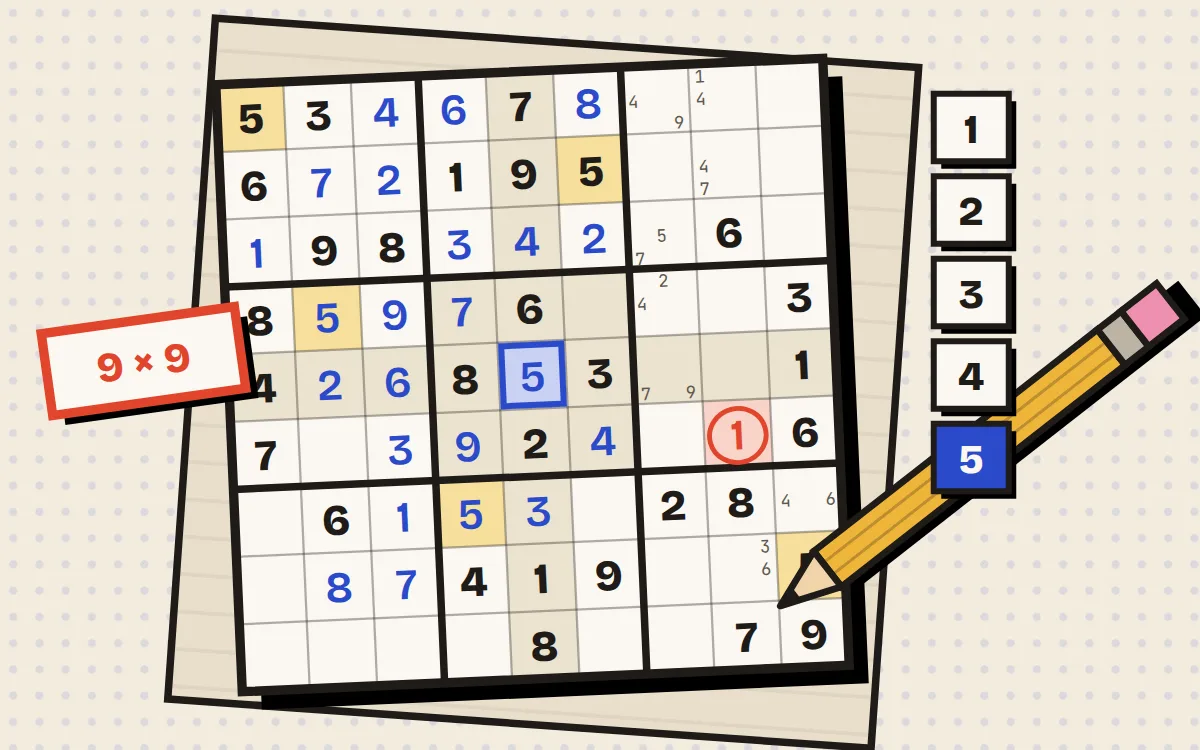
Fill the 9×9 grid so every row, column and box holds 1 to 9. Four levels and a daily puzzle.

01

How to play

  1. Pick an empty square by tapping it or moving to it with the arrow keys.
  2. Enter a digit from 1 to 9 that is not already in that row, column or 3×3 box.
  3. Switch on Notes to pencil in small candidates when you are unsure. Clashing digits turn red.
  4. Fill every square correctly to solve the puzzle. Use Undo, Redo or a Hint if you get stuck.
02

Controls

Keyboard & mouse

←↑→↓
Move between squares
1-9
Enter a digit
N
Toggle notes (or hold Shift while typing)
Backspace0
Clear square
CtrlZ
Undo (Ctrl+Y to redo)
H
Hint
PEsc
Pause

Touch

Tap a square
Select it
Tap the number pad
Enter a digit
Tap the pencil button
Toggle notes
Tap the bulb button
Get a hint
03

About

The classic 9×9 number puzzle: fill every row, column and 3×3 box with the digits 1 to 9, each exactly once. Every grid has a single answer you can reach by logic alone, from gentle Easy puzzles to Expert ones, plus a daily puzzle that is the same for everyone.Also known as Sudoku, Su Doku, Number Place, Number Sudoku, Classic Sudoku, 9x9 Sudoku, Daily Sudoku, Sudoku puzzle.

04

Tips & tricks

  • Take one digit at a time and check each box: rows and columns that already hold it often leave only one square.
  • Start with rows, columns and boxes that have just one to three gaps.
  • Note only the area you are working on and let auto notes tidy up as you place digits.
  • If two squares in a unit can only hold the same two digits, cross those digits off the rest of the unit.

Sudoku: complete guide

Sudoku is the classic 9×9 number puzzle: fill the grid so every row, column and 3×3 box holds the digits 1 to 9 exactly once. Play Sudoku online free here, from gentle Easy grids to Expert puzzles, plus a new daily puzzle that everyone gets on the same day.

How to play Sudoku

The board is a 9×9 grid split into nine 3×3 boxes. Some squares start filled in. These are the givens, printed in dark ink, and they cannot be changed. Your job is to fill every empty square with a digit from 1 to 9.

There is only one rule, applied three ways: no digit may repeat in a row, in a column or in a box. Every puzzle on PlayNest is checked by a solver before you see it, so each one has exactly one correct answer, and it can always be reached by reasoning rather than guessing.

  • Pick a square by tapping it or moving to it with the arrow keys.
  • Tap a number on the pad, or type it, to fill the square. Your digits appear in cobalt blue.
  • Turn on Notes to pencil in small candidate digits while you work something out.
  • If two equal digits share a row, column or box, both turn tomato red so you can spot the clash.
  • Fill the last square correctly and the puzzle is solved.

Controls

On a phone or tablet, tap a square, then tap a digit on the number pad under the grid. Under the pad are Undo, Redo, Erase, Notes and Hint. On a wide screen the pad sits beside the grid instead.

On a keyboard, the arrow keys move around the grid and wrap at the edges. Type 1 to 9 to enter a digit. Backspace, Delete or 0 clears a square. N switches Notes on and off, and holding Shift while typing a digit adds a note without switching modes. Ctrl+Z (Cmd+Z on a Mac) undoes, and Ctrl+Y or Ctrl+Shift+Z redoes. H asks for a hint, and P or Escape pauses.

Each key on the number pad shows a small count of how many of that digit are still missing. When all nine are on the board, the key greys out, which is a quick way to see which digits are finished.

Difficulty levels and the daily puzzle

Every puzzle is made fresh when you start, and the difficulty is set by two things: how many givens you get, and which solving techniques the puzzle actually needs. After making a grid, the game solves it the way a person would and keeps it only if it matches the level you chose.

  • Easy: about 36 to 38 givens. Every step is a single: a square with only one possible digit, or a digit with only one possible square.
  • Medium: about 28 to 32 givens. You will need at least one step beyond singles, such as a pointing pair or a naked pair.
  • Hard: usually 24 to 28 givens. Expect pairs, and sometimes triples or an X-wing.
  • Expert: as few givens as the generator can manage while keeping a single answer, and a logic chain that goes beyond the techniques above. Notes are close to essential here.
  • Daily puzzle: one Medium grid per day, built from the date, so everyone playing that day solves the same Sudoku. Your daily solve time is saved and the game marks the day as done.

Timer, mistakes, hints and saving

A clock runs while you play. It stops when you pause, open the rules or settings, or switch to another tab, and the grid is hidden while paused so the clock stays fair. When you finish, you see your time, the hints you used, your mistakes if checking was on, and your best time for that difficulty. Best times are kept in your browser.

By default the game only warns you about clashes you can see. If you want stricter feedback, switch on Check mistakes in settings. Any digit that does not match the solution is then struck through in tomato red, and each wrong entry adds one to the mistake counter. Undo will not take a counted mistake back.

Hint is a gentle nudge. If the selected square is empty or wrong, it fills that square. Otherwise it fixes any wrong digit on the board, and if there are none it finds the easiest next step and tells you why it works, for example that only a 7 fits in a certain square. Revealed squares get a small mustard corner and are locked in.

Your game is saved after every move, including notes and undo history, so you can close the tab and continue later from the main menu.

Sudoku strategy that actually helps

Most puzzles fall to a handful of ideas used in the right order. Start with the cheapest checks and only reach for the heavy tools when you are stuck.

  • Cross-hatch digit by digit. Pick a digit, say 5, and look at each box. The rows and columns that already hold a 5 rule out squares in that box. Often only one square is left.
  • Look for the last square in a unit. A row, column or box with eight digits filled is free money, and so is one with only two or three gaps.
  • Count candidates. A square whose row, column and box together already contain eight different digits can only take the ninth one. This is the naked single.
  • Use notes on the hard parts only. Pencilling every square at once is slow. Note the boxes you are working on and let auto notes clear them as you place digits.
  • Pointing pairs: if a digit's only possible squares in a box sit on one row, that digit cannot appear anywhere else on that row.
  • Naked pairs: if two squares in a unit can only be 3 or 8, those two digits belong to them, so cross 3 and 8 off the rest of the unit.
  • X-wing: if a digit has exactly two possible squares in each of two rows, and they line up in the same two columns, you can remove it from the rest of those columns.
  • When you go wrong, undo rather than erase. Undo walks back through notes as well, which saves rebuilding your thinking.

A short history of Sudoku

The idea behind Sudoku goes back to the Latin squares studied by the Swiss mathematician Leonhard Euler in the 1700s, grids where every symbol appears once in each row and column. The modern puzzle, with its 3×3 boxes, first appeared in 1979 in an American puzzle magazine under the name Number Place, and is usually credited to the puzzle maker Howard Garns.

In 1984 the Japanese publisher Nikoli picked it up and gave it the name Sudoku, a shortening of a phrase meaning that the digits must stay single. Nikoli also popularised the habit of symmetric givens and hand-crafted puzzles, which this game keeps with its rotationally symmetric grids. Sudoku reached a world audience in 2004 when a British newspaper began printing it daily, and within a year it was in papers, books and phones everywhere.

05

Sudoku FAQ

Is Sudoku free to play?
Yes. Sudoku is completely free on PlayNest. There is nothing to buy and no account to create.
Do I need to download Sudoku?
No. Sudoku runs in your web browser, so you can start playing straight away on Chrome, Safari, Edge or Firefox.
Can I play Sudoku on my phone?
Yes. Sudoku works on Android phones, iPhones, tablets and computers, with touch and keyboard controls.
How many players can play Sudoku?
It is a single-player game.
How long does a game of Sudoku take?
A round takes about 12 minutes. It is rated medium and sits in our Puzzle & Brain collection.
Does every Sudoku here have only one solution?
Yes. Before a puzzle reaches you, a solver counts its solutions and the game only removes a given if exactly one answer remains. You never have to guess between two valid endings.
What makes a Sudoku Hard or Expert rather than Easy?
Fewer givens is part of it, but the bigger difference is the logic needed. The game solves each grid like a person and checks which techniques it had to use. Easy needs only singles, Medium needs pairs or pointing, Hard brings in triples and X-wings, and Expert needs more than all of those.
Is the daily Sudoku the same for everyone?
Yes. The daily puzzle is built from the date, so everyone who plays on the same day gets the same Medium grid. A new one appears after midnight in your local time.
Do hints or mistakes affect my best time?
Your best time is the fastest finish for each difficulty. The win screen shows the hints you used and, if Check mistakes was on, how many wrong digits you entered, so you can decide for yourself what counts as a clean solve.
Can I leave a puzzle and finish it later?
Yes. The game saves after every move, including your notes and undo history. Open Sudoku again and choose Continue on the main menu. The clock picks up where it stopped.
What are notes and auto notes?
Notes are small pencil marks for the digits a square might hold. Switch them on with the Notes button or N, or hold Shift while typing. With auto notes on, placing a digit removes that digit from the notes in the same row, column and box.
06

You might also like

More Puzzle & Brain