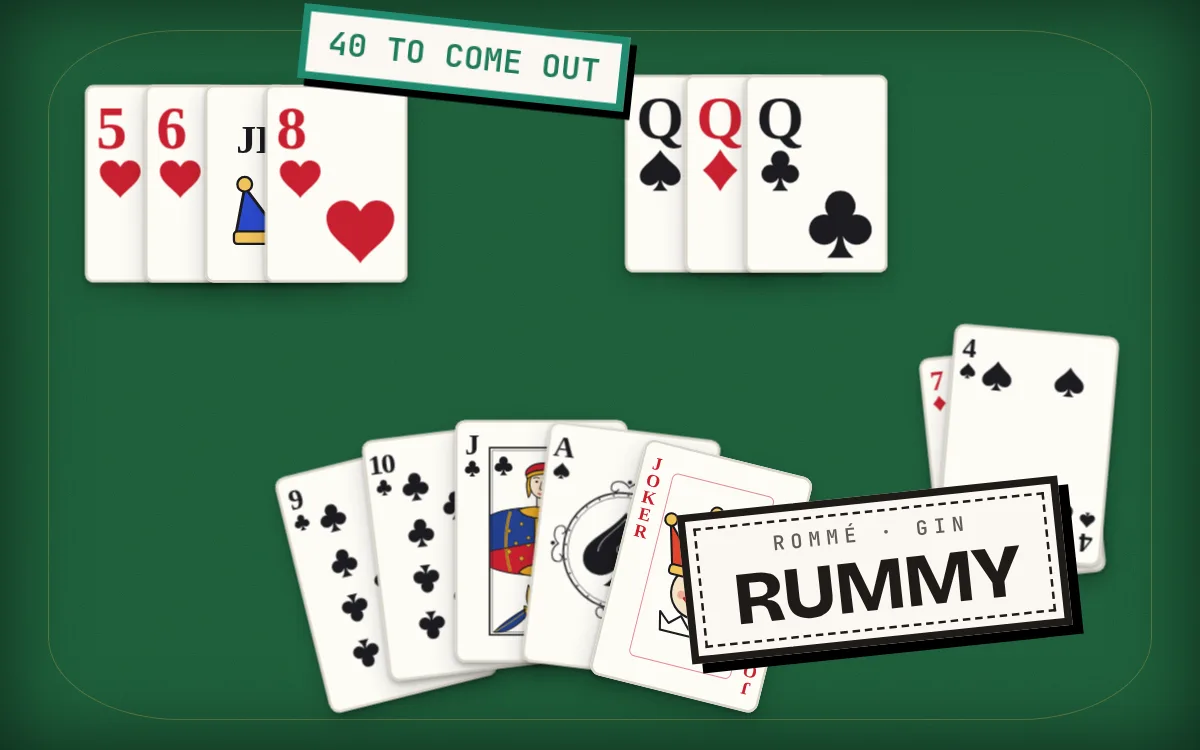
Rummy is the card game of melds: draw a card, lay down sets and runs, discard, and be the first to get rid of your hand. This page brings together Rommé, the German and Austrian rummy played with two decks and jokers, the classic Basic Rummy of British and American kitchen tables, and two-player Gin Rummy with its knocks, gins and undercuts. Play Rummy online free against 1 to 5 computer opponents or invite friends with a link, in any phone or desktop browser, with no download and no sign-up.
Every kind of rummy works the same way at heart. You hold a hand of cards and want to turn it into melds, which are groups that belong together. On each turn you take one card in and put one card out, so your hand slowly improves. The first player to use up every card goes out and wins the hand.
A turn always has the same three steps:
- Draw: take the top card of the face-down stock, or the top card of the face-up discard pile.
- Meld (optional): lay down sets or runs from your hand, and, once you are allowed to, add cards to melds already on the table.
- Discard: put one card face up on the discard pile. That ends your turn.
- A set is 3 or 4 cards of the same rank in different suits, such as 8 of hearts, 8 of spades and 8 of clubs.
- A run is 3 or more cards in sequence in one suit, such as 5, 6, 7 and 8 of diamonds.
- You go out when your last card is melded, laid off or discarded.
Sets need different suits, so two 8s of hearts can never sit in the same set, even when two decks are in play. Runs must stay in one suit. The Ace can be low (A, 2, 3) or high (Q, K, A) in Rommé, but a run never wraps around the corner: K, A, 2 is not allowed. In Gin Rummy the Ace is always low, and in Basic Rummy it is low unless you switch on the Ace high or low house rule.
Jokers are wild. A joker can stand in for any card in a set or a run, but every meld needs at least two natural cards, so a joker and two natural cards make a legal meld while two jokers and one natural card do not.
Laying off means adding cards from your hand to a meld that is already on the table, yours or anyone else's. A 9 of diamonds can extend someone's 6, 7, 8 of diamonds, and a fourth Queen can join a set of three Queens. You may only lay off once you have made your own first meld.
A joker swap lets you take a joker back from the table. If a run on the table is 4, joker, 6 of spades, you can put the real 5 of spades in its place and take the joker into your hand. The joker must then be used straight away, in a meld or a layoff during the same turn. Like laying off, swapping is only allowed after your first meld.
In Rommé the default house rule says a card taken from the discard pile must be used that same turn. In every mode you may not throw back the card you have just picked up from the pile.
Rommé is the default mode and the way rummy is played in Germany and Austria. It takes 2 to 6 players and uses 110 cards: two standard 52-card decks plus six jokers. If you prefer fewer wild cards, the house rules let you play with 2 or 4 jokers instead. Each player is dealt 13 cards.
The rule that gives Rommé its character is coming out, called Rauskommen in German. Your first meld, or melds, must all be laid in a single turn and must add up to at least 40 points. Cards in melds count like this: Ace 11 (but only 1 when it sits low in A, 2, 3), King, Queen and Jack 10, number cards their face value, and a joker counts as the card it replaces. If your table plays it differently, the house rules offer a 30 point minimum or no minimum at all.
Until you have come out you cannot lay off on other melds or swap jokers, so your first job is to collect 40 points of melds without giving away too much on the discard pile.
Hand Rommé is the big prize. If you go out in one single turn without having melded anything before, every other player's penalty points for that hand are doubled.
If the stock runs out, the discard pile, except its top card, is shuffled to make a new stock. This happens once. If the new stock runs out too, the hand is void and nobody scores.
Basic Rummy, also called Rum or Straight Rummy, is the version many people learnt first in the UK and the US. It uses one 52-card deck, with no jokers by default or 2 jokers as an option. How many cards you get depends on the table: 10 each with 2 players, 7 each with 3 or 4 players, and 6 each with 5 or 6 players.
There is no first-meld minimum unless you switch one on, so you can put down a three-card run on your very first turn. The Ace is low by default, and the Ace high or low house rule lets it close a Q, K, A run as well. Once you have melded you may lay off and swap jokers, exactly as described above.
Going out all in one turn, laying your whole hand down at once without any earlier meld, is called going rummy and doubles the score for that hand.
There are two scoring systems, and either one can be chosen in Rommé or Basic Rummy from the house rules.
Penalty points is the Rommé default. When a player goes out, everyone else adds up the cards left in their hand and those points go against them. When someone reaches the target, 250, 500 or 1000 points with 500 as the default, the match ends and the player with the lowest total wins. Penalty values are: Joker 20, Ace 11, King, Queen and Jack 10, and number cards their face value.
Winner collects is the Basic Rummy default. The player who goes out scores the total of everyone else's hands, using Ace 1, face cards 10, number cards face value and joker 15. The first player to reach the target, 100, 250 or 500 points with 100 as the default, wins the match.
After each hand a round summary shows what everyone was caught holding, the running totals and the score history.
Gin Rummy is the two-player duel. It uses one 52-card deck with no jokers and each player gets 10 cards. The Ace is always low, so A, 2, 3 is a run but Q, K, A is not. Aces count 1, face cards 10 and number cards their face value.
The first turn has its own ritual. The first upcard is offered to the non-dealer, who may take it or pass. If they pass, the dealer may take it or pass. If both pass, the non-dealer draws from the stock and normal play begins. After that, each turn is draw from the stock or the discard pile, then discard. You cannot discard the card you just took from the pile.
Unlike the other modes, nobody lays melds on the table during play. Instead you aim to reduce your deadwood, the cards that are not part of any meld. The game always arranges your melds to give the lowest possible deadwood and shows the count on screen at all times.
- Knock: when your deadwood after discarding is 10 or less, a Knock button appears. Knocking ends the hand and both hands are shown.
- Laying off: after a knock, the defender may lay off cards on the knocker's melds to cut their own deadwood.
- Knock points: the knocker scores the difference between the two deadwood counts.
- Undercut: if the defender's deadwood is equal to or lower than the knocker's, the defender scores the difference plus 25.
- Gin: knocking with 0 deadwood scores 25 plus the opponent's deadwood, and the opponent may not lay off.
- Big Gin: if all 11 cards in your hand form melds after you draw, you go out without discarding and score 31 plus the opponent's deadwood.
- Draw: if only 2 cards are left in the stock and nobody has knocked, the hand is a draw.
A Gin match is played to 100 points by default, or to 150 or 250. The player who reaches the target gets a 100 point game bonus, plus a 25 point box bonus, sometimes called a line bonus, for every hand they won. If the loser did not score a single point in the whole match, it is a shutout and the winner's total is doubled.
Both are draw and discard games built on sets and runs, but they feel very different. In Rummy and Rommé melds go on the table as soon as you make them, everyone can lay off on everyone's melds, jokers can be in play and up to six people can sit at the table. In Gin Rummy only two play, there are no jokers, your melds stay hidden in your hand and the hand usually ends with a knock rather than with someone using every card.
That changes the skill. Rummy rewards watching the table and timing your melds so that others cannot use them. Gin rewards counting: knowing which cards are dead, keeping your deadwood low and choosing between knocking early or waiting for gin. You can switch between them from the setup screen.
To play on your own, choose 1 to 5 computer opponents (one in Gin Rummy) and pick a level. Easy computers make simple melds and loose discards. Normal computers play solidly. Hard computers track the discard pile and remember what each player picks up, so they avoid feeding the next player the card they are waiting for.
To play with friends, create a room and share the link, or the 6-letter room code, on WhatsApp or anywhere else. Friends join from their own phone or computer, the computer fills any seat left empty, and you can chat with text and emoji, or turn on voice chat. There is nothing to download and no account to make.
A few tools make melding easier on a small screen. Drag cards to rearrange your hand, or sort by suit or by rank. The Suggest button finds a meld, or a layoff, in your hand and selects it for you. Before you come out in Rommé, a staging tray shows your running total against the 40 point minimum, so you know when you have enough. Tap a meld on the table to lay off the selected card or to swap a joker.
On a computer you can also use the keyboard: D draws from the stock, P takes the discard, M melds the selected cards, Enter discards the selected card, S sorts, H suggests, K knocks in Gin and Esc clears your selection. Your stats, including games played, games won and streaks, are saved in your browser, and an unfinished game against the computer is saved so you can pick it up later.
Good players waste fewer cards. These habits help in every mode:
- Get rid of high cards early. An unmatched King or Ace is 10 or 11 penalty points if someone goes out before you use it.
- Keep cards that can grow both ways. A 6 and 7 of the same suit wait for a 5 or an 8, while a pair of 6s only waits for two cards.
- Watch the discard pile. If the player before you threw a 9 of clubs, they are probably not collecting clubs around 9.
- Do not feed the next player. If they just picked up a Jack from the pile, think twice before discarding another Jack.
- In Rommé, do not rush to come out with a weak 40. Melding too early can leave your hand thin while opponents lay off on your runs.
- Use a joker where it does the most work, usually in the middle of a run, and swap jokers back from the table when you can.
- Going for Hand Rommé is high risk. It pays double, but holding 13 cards while others go out can cost you a lot of points.
- In Gin, knock early when the opponent has taken several discards, and hold out for gin only when your deadwood is already close to zero.
For children, start with Basic Rummy against Easy computers. One deck, no jokers and no first-meld minimum keep the rules short, and the Suggest button shows what a set or a run looks like.
Adults who grew up with Rommé at family gatherings can switch on 6 jokers and the 40 point rule and take on Hard computers, which remember the discards. Gin Rummy is the quick two-player choice for a lunch break.
Card historians usually trace the rummy family to the 19th century. One early ancestor is Conquian, a draw and meld game played in Mexico and the American southwest. By the early 1900s games called Rum or Rummy were popular in the United States and soon spread to Britain.
Gin Rummy is often credited to Elwood T. Baker around 1909, though the story is hard to prove. It became famous in the 1930s and 1940s, especially in Hollywood. In Germany and Austria the two-deck game with jokers became known as Rommé, and boxed Rommé packs with 110 cards are still a standard sight in German households. In France the same family of games is called Rami.
Hier kannst du Rommé online kostenlos spielen, ohne Anmeldung und ohne Download, direkt im Browser auf Handy oder PC. Gespielt wird mit 110 Karten, also zwei Kartenspielen und bis zu sechs Jokern, und jeder Spieler bekommt 13 Karten. Zum Rauskommen brauchst du 40 Punkte, und wer Hand Rommé schafft, verdoppelt die Strafpunkte aller Mitspieler. Du spielst gegen den Computer in drei Stärken oder mit Freunden über einen Link oder einen Raumcode. Außerdem gibt es Basic Rummy und Gin Rummy für zwei Spieler.