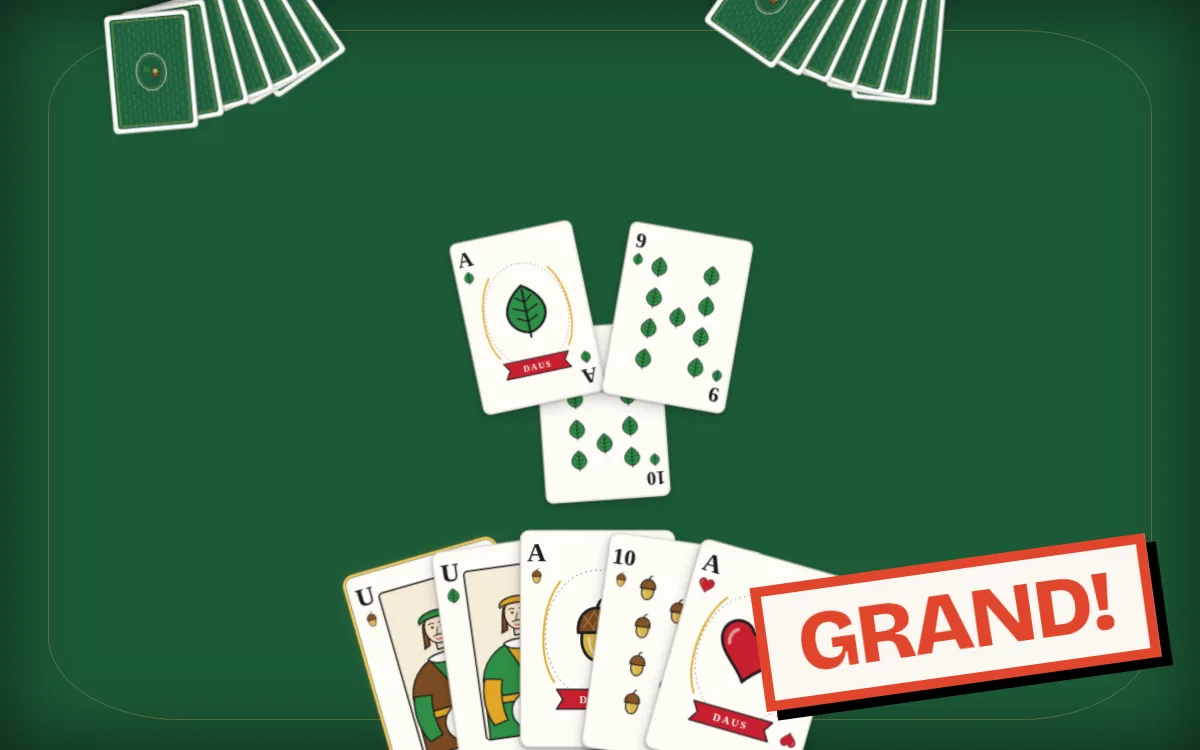
Skat is Germany's national card game: three players, a 32-card deck, a sharp bidding auction and one declarer who plays alone against the other two. If you want to play Skat online, or as German players put it, Skat online spielen kostenlos und ohne Anmeldung, this page lets you play free in your browser against Easy, Normal or Hard computer opponents, or with friends through a room link. Below you will find the full rules as played under the International Skat Order (ISkO), how bidding and the game value work, the two scoring systems, Ramsch, strategy for beginners and a short history of the game.
Skat is a trick-taking game for three active players. Each hand has three phases: the bidding (Reizen), where players compete to become the declarer; the choice of game, where the declarer picks up the two hidden Skat cards or plays without them; and the card play, ten tricks in which the declarer tries to win at least 61 of the 120 card points.
One hand works like this:
- The dealer gives every player ten cards and puts two cards face down in the middle. Those two cards are the Skat.
- The player on the dealer's left is Vorhand (forehand), the next is Mittelhand (middlehand), and the dealer is Hinterhand (rearhand). Play always goes clockwise.
- Players bid numbers that stand for game values. The highest bidder becomes the declarer and the other two become partners for this hand.
- The declarer either takes the Skat and discards two cards, or plays Hand without looking at it, then announces the game: Diamonds, Hearts, Spades, Clubs, Grand or Null.
- Vorhand leads the first trick. You must follow the suit that was led, and remember that in suit games and Grand the Jacks belong to the trump suit, not to their printed suit.
- After ten tricks the card points are counted. The declarer needs 61 or more; the defenders win with 60.
Skat uses 32 cards: 7, 8, 9, 10, Jack, Queen, King and Ace in four suits. With German-suited cards the suits are Eichel (acorns), Grün (leaves), Herz (hearts) and Schellen (bells), and the Jack and Queen are called Unter and Ober. You can switch between the German deck and the French deck (Kreuz, Pik, Herz, Karo) in the game settings.
In a suit game there are eleven trumps. The four Jacks are always the highest, in a fixed order: Jack of Clubs, Jack of Spades, Jack of Hearts, Jack of Diamonds. Below them come the Ace, Ten, King, Queen, 9, 8 and 7 of the chosen trump suit. In the other suits the order is Ace, Ten, King, Queen, 9, 8, 7. Notice that the Ten ranks above the King.
Card points decide who wins the hand: Ace 11, Ten 10, King 4, Queen 3, Jack 2, and nothing for 9, 8 and 7.
Bidding in Skat is not a free choice of numbers. Every bid is a game value that could actually be played: 18, 20, 22, 23, 24, 27, 30, 33, 35, 36, 40, 44, 45, 46, 48, 50, 54, 55, 59, 60 and upwards. The lowest bid, 18, is the smallest possible game: Diamonds with or without one Jack, worth 9 x 2.
Mittelhand starts by saying values to Vorhand. Vorhand answers 'ja' (hold) to keep the value or 'weg' (pass) to drop out. When one of them passes, Hinterhand continues bidding against the survivor in the same way. If Mittelhand and Hinterhand both pass straight away, Vorhand may play a game at 18 or pass too. If all three pass, the hand is played as Ramsch when that option is on; otherwise the cards are thrown in and the next dealer deals.
On our table the bidding buttons show the next value with the German word beside it, for example 'Hold (ja)' and 'Pass (weg)'.
The declarer may pick up the two Skat cards, add them to the hand and then lay away any two cards face down. This is called drücken. The points in the discarded cards count for the declarer at the end, so putting away an unprotected Ten is a classic move.
Alternatively, the declarer can play Hand: the Skat stays untouched and the declarer announces the game straight from the ten cards. Hand earns one extra multiplier, and only in a Hand game may you announce Schneider, Schwarz or Ouvert for even more. The Skat still belongs to the declarer and its points are added after the last trick.
Every game has a base value: Diamonds (Karo, Schellen) 9, Hearts (Herz) 10, Spades (Pik, Grün) 11, Clubs (Kreuz, Eichel) 12 and Grand 24. The game value is the base value times a multiplier.
The multiplier starts with the matadors, also called Spitzen. Count the top trumps you hold in an unbroken run from the Jack of Clubs downwards: holding the Jack of Clubs and the Jack of Spades but not the Jack of Hearts means you are 'with 2' (mit 2). If you do not hold the Jack of Clubs, count how many top trumps are missing before your highest one: without the two black Jacks you are 'without 2' (ohne 2). The Skat counts as part of the declarer's cards here, even in a Hand game.
Then add one for the game itself and one for each extra level reached:
- +1 for the game (so 'with 2' becomes 'with 2, game 3').
- +1 for Hand.
- +1 for Schneider: one side ends with 30 card points or fewer.
- +1 for Schneider announced (Hand games only).
- +1 for Schwarz: one side takes no trick at all.
- +1 for Schwarz announced (Hand games only).
- +1 for Ouvert: the declarer plays with all cards face up (Hand only, and Schwarz is announced with it).
With 2, game 3, Clubs: 3 x 12 = 36. Without 1, game 2, Hearts: 2 x 10 = 20. With 1, game 2, Hand, Spades: 3 x 11 = 33. A Grand with 2, game 3, Schneider: 4 x 24 = 96.
The highest possible game value in Skat is 264: a Grand with all four Jacks (with 4), game 5, Hand 6, Schneider 7, Schneider announced 8, Schwarz 9, Schwarz announced 10, Ouvert 11, so 11 x 24 = 264. While you choose your game, the table shows a live calculator with the value for the game you are about to announce, and after each hand a breakdown explains exactly how the score was reached.
If the value of the game you actually play is lower than your bid, you have overbid (überreizt) and the game is lost, even if you took 61 points or more. The lost value is the lowest multiple of the base value of your game that reaches the bid.
Example: you hold the Jack of Clubs and bid 30, hoping the Skat holds the Jack of Spades so you could play Hearts 'with 2, game 3' for 30. The Skat brings nothing useful, so you play Hearts 'with 1, game 2', worth only 20. The game is lost, valued at 3 x 10 = 30, and under the Skat list rules a lost game counts double, so you score minus 60. This is why careful players count matadors before they say the next number.
In a Grand only the four Jacks are trumps. All four suits rank Ace, Ten, King, Queen, 9, 8, 7. The base value is 24, so a Grand is worth much more than a suit game and is the natural choice when you hold three or four Jacks and long runs of Aces and Tens.
Null is the opposite: the declarer must lose every trick. There are no trumps and the cards rank in natural order 7, 8, 9, 10, Jack, Queen, King, Ace in each suit. Null games have fixed values with no matadors: Null 23, Null Hand 35, Null Ouvert 46 and Null Ouvert Hand 59. In Ouvert games the declarer's cards are laid open for the defenders to see before the first trick.
A suit game or Grand can also be played Ouvert, but only as a Hand game, and it always includes Schwarz announced: the declarer must win every single trick with an open hand.
The standard Skat list follows the International Skat Order: a won game adds its value to the declarer's score, and a lost game subtracts twice its value. The defenders score nothing directly; they gain by keeping the declarer down.
Seeger-Fabian is the tournament system used in clubs. It keeps the same game values and adds 50 points for every won game and takes 50 away for every lost game. When the declarer loses, each opponent also receives 40 points at a three-player table or 30 points at a four-player table. You can choose either system before a match, and the score list shows both columns side by side. A match lasts 12, 24 or 36 games; 36 is the length of a typical tournament series.
Ramsch is the hand played when all three players pass, if the Ramsch option is switched on. There is no declarer: everyone plays alone, only the four Jacks are trumps, and the aim is to take as few card points as possible.
The player with the most card points scores minus that number. A player who takes no trick at all is a Jungfrau (virgin), which doubles the loser's minus score. If one player wins every trick, that is a Durchmarsch and scores plus 120. The two Skat cards go to whoever wins the last trick, so be careful with your final card. Schieberamsch, where the Skat is passed around, is not part of this version.
A few habits help new players win more games and lose fewer points:
- Value your hand before the auction. Count the Jacks, find your longest suit and work out the game value, then do not bid past it.
- Two Jacks plus five cards of one suit with an Ace is a solid suit game. Three Jacks and two or three Aces with Tens is often a Grand.
- As declarer, lead trumps early to draw the defenders' Jacks, then cash your Aces and Tens.
- When you take the Skat, discard a lonely Ten or a suit you want to be void in. The discarded points are already yours.
- As a defender, play the side suits the declarer is short in and put a high card (schmieren) on your partner's winning trick.
- Keep count of the Jacks and the Tens. Once you know where they are, the last tricks play themselves.
- Only play Null when you hold mostly low cards in every suit, or a single high card you can throw away early.
You can play Skat against the computer at three levels. Easy bids cautiously and makes the kind of mistakes beginners make, so it is a good place to learn bidding and counting. Normal plays sound, rule-based Skat. Hard is a real challenge: it tracks every card played and which suits each player is out of, simulates the possible unseen hands and looks ahead to the end of the hand, and its bidding is also based on simulating how the hand would play.
You can choose a relaxed, normal or fast play speed, and local matches are saved in your browser, so you can close the tab and continue later. Your statistics record games played, games won as declarer, matches won and your best match total. Signed-in players also collect achievements and appear on the most wins leaderboard.
To play Skat with friends online, open a room and share the six-character room code or the link, for example with the WhatsApp button. Friends join from their own phones or computers, and computers fill any empty seats. If a friend's connection drops, a computer plays for them until they come back. There is also a quick match with other players, table chat with emoji and quick phrases, and optional voice chat.
Skat is always played by three active players, but four people often sit at one table. In that case the dealer (Geber) sits out each hand and the role moves round the table, so everybody plays three hands out of every four. Our optional four-player table works exactly like this.
Click or tap a card to play it. On a touch screen the first tap lifts the card and the second tap plays it, so you do not play a card by accident. Bidding and the game choice use big buttons. On a keyboard, Tab moves between cards and buttons and Enter plays or presses them, Esc opens the menu and L shows the last trick. Your hand is sorted automatically for the current game with trumps first, legal cards are highlighted, and fullscreen and a sound mute button are in the menu.
Skat and Schafkopf share the 32-card deck, the card points and the target of 61, and Skat grew partly out of an older form of Schafkopf. The differences are big, though. Skat has three active players with ten cards each, a two-card Skat and a numeric auction. Schafkopf has four players with eight cards each, and in the normal game all Ober and Unter are trumps along with the Hearts.
In Schafkopf the most common game is the Sauspiel, where you call an Ace and its holder becomes your secret partner, while in Skat the declarer always plays alone. If you like Skat, try [Schafkopf online](/game/schafkopf), the Bavarian cousin.
Skat was developed in the town of Altenburg in Thuringia in the early nineteenth century, around 1810 to 1820, by players who combined ideas from Schafkopf, Tarock and the Spanish game L'Hombre. The name comes from the Italian word scartare, to discard, after the two cards laid away.
The first Skat congress met in Altenburg in 1886, the German Skat Association was founded in 1899, and the town is still home to the Skat court that settles rules disputes, as well as a fountain dedicated to the game. Since 1998 German and international players have used one common rulebook, the International Skat Order, and in 2016 Skat was added to Germany's national list of intangible cultural heritage.
Hier kannst du Skat online kostenlos spielen, direkt im Browser und ohne Anmeldung. Spiele gegen drei Computerstärken (leicht, normal, schwer) oder lade Freunde mit einem Raumcode oder Link an deinen Tisch ein. Gespielt wird nach der Internationalen Skatordnung mit vollem Reizen, Hand, Schneider, Schwarz, Ouvert, Grand und Null, auf Wunsch mit Ramsch. Du wählst zwischen deutschem und französischem Blatt und zwischen Skatliste und Seeger-Fabian Wertung.