Blog
Mahjong Solitaire strategy: how to clear the board every time
Most lost games of Mahjong Solitaire are lost in the first minute, by taking a pair that looked harmless. This guide shows what to look for before you click, the dead-end patterns to avoid, and a simple order of play that clears the board far more often.
9 min readUpdated By PlayNest team
The one rule behind every strategy
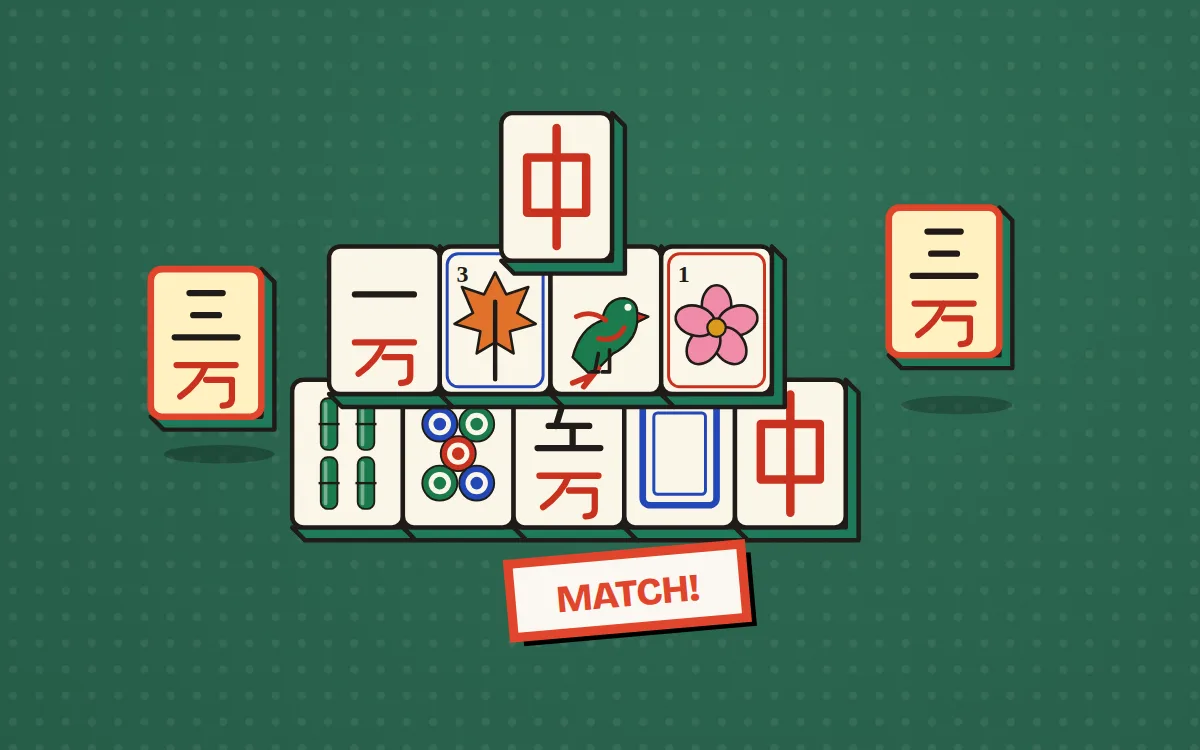
Everything in Mahjong Solitaire follows from a single rule: you may only take a tile that is free. A tile is free when nothing sits on top of it and either its left side or its right side is open. You remove tiles in matching pairs, so a good move is not just a legal match. It is a match that opens the tiles you will need next.
In our Mahjong Solitaire game, tiles that are blocked are dimmed, so the free ones stand out at a glance. If you are new to the tile set itself, read Mahjong tiles explained first, then come back here.
A useful way to think about it: every tile is either a door or a lock. Tiles on top of stacks and at the end of rows are doors, because removing them lets other tiles out. Tiles buried in the middle are locks, because they stay stuck until the doors above and beside them are gone. Good play opens the doors that hold the most locks.
Scan the board before your first click
Spend ten seconds looking before you take anything. You are not trying to solve the whole board, only to learn where the trouble is.
- Find the tallest stacks. Tiles under four or five others are the slowest to free, so they will decide how fast you finish.
- Look for long rows. Whichever end of a long row you open first will unlock the whole row, one tile at a time.
- Pick one tile you can see and count its four copies. Where are the other three? If two are buried deep, that tile type will be your bottleneck.
- Notice tiles that sit alone on the left or right edge. They are free from the start but often form the only pair you can use, so do not waste them early.
Tip
In our game, the Pairs counter at the top shows how many matching free pairs exist right now. If it is low, be careful: you are close to a stall.
Work the tallest stacks first
The classic Turtle layout has a central tower five tiles tall. That one tile on top is free from the first move, and under it are four more levels of tiles that cannot be touched until it is gone. If you leave the tower to the end, you will find its tiles have no partners left that you can reach.
Free the middle early. Take the top tile of a high stack and a matching free tile elsewhere, and the layer beneath becomes available. Each level you open gives you new pairs to choose from, and more choice means fewer stalls.
The same logic works on the other layouts. On the Pyramid, start at the apex and work down the steps. On the Fortress, take the tower tops before you touch the walls, because the towers cover the walls' corners.
Open long rows from one end
A tile with neighbours on both sides is blocked, but one open side is enough to make it free. That means you never need to clear a whole row to use its tiles. Remove the end tile, and the next tile in the row becomes free from that side, then the next one, and so on.
Pick the end that also uncovers something. If one end of a row sits under a raised tile and the other does not, start at the open end and let the raised tile come off later when you have a partner for it. Opening a row from both ends at once can leave you with two tiles in the middle that are hard to pair.
Count the four copies before you take a pair
Each standard tile has four copies, which is two pairs. The hardest moments come when the last copies of a tile are all in awkward places. Before you take a pair, look at the other two copies of that tile.
- If the other two copies are both free, you can take this pair without worry and keep the other pair for later.
- If one of the other two copies is free and one is buried, take this pair if it helps uncover the buried tile, and leave the free partner alone until the buried one is out.
- If both other copies are buried, take the free pair that uncovers them, even if another free pair looks more tempting.
- If you are about to take the last free pair of a kind and a tile you need is trapped underneath, stop. You may be locking yourself out of a way to finish.
The stacked-twins trap and other dead ends
The most common dead end is a stack of identical tiles. Imagine two copies of the same tile, one directly on top of the other. They look like a ready-made pair, but they are not, because the lower tile is covered and cannot be picked until the upper one is gone. To clear the stack, you must pair the upper tile with another copy elsewhere, then pair the lower tile with the last copy elsewhere.
That means both outside copies must still be on the board. If you take either of them as part of another move, the stack can never be cleared. When you see twins stacked, protect their two outside partners.
Other dead ends to watch for: a lone tile under another tile with nothing else left, and two pairs that each cover the other's partners. If the tiles on the board are arranged this way, no shuffle can help, because the shape itself cannot be cleared. In our game, when this happens the shuffle button tells you it cannot help, and undo is the way out.
Tip
When two identical tiles are stacked, count their two outside copies. If either is gone, the stack cannot be cleared.
Choosing between two identical pairs
Often you will have four free tiles of one kind and can choose which pairs to take. They look the same, but the choice changes the board. Pick the pair that uncovers more tiles. If one tile is on top of a stack and another is at the edge of an open row, take the stack tile.
When it makes no difference to what is uncovered, prefer the pair that keeps your remaining free tiles varied. A board with many different free tiles is more likely to give you a match next turn than one where every free tile is a different, unrelated kind.
Use flowers and seasons as your safety valve
Any flower matches any other flower, and any season matches any season. With four tiles in each group, they are the most flexible pairs on the board, so they are a safety valve when you need to take something out.
Do not spend them on the first move just because they are free. Save them for moments when no other pair is available, or when a flower or season sits on top of something you want to uncover. Used well, they get you through a tight spot that would otherwise have forced a shuffle.
Hint, undo and shuffle: use them in that order
When you stall, try the tools from the gentlest to the strongest. Hint comes first: in our game it searches for a real route to the end of the board and shows the first step, so it never leads you into a dead end when a way out exists. Hints are counted in your results, and a clean win on a large layout earns a badge, so use them when you need them, not by habit.
Undo comes second. It is unlimited, so use it freely to take back a pair that you now regret. Going back a few moves and picking a different pair is often the cheapest fix.
Shuffle comes last. You get three per game, and each one re-deals the remaining tiles in a way that is guaranteed to be winnable. Do not use one the moment a board looks hard. Save them for true stalls, when no matches remain.
A practice plan: which layout to play in which order
Learn the habits on small boards first, then carry them to bigger ones. The start panel shows a difficulty rating for each layout, and it remembers your best time on every one.
- Easy, 36 tiles: learn to see free tiles and to count copies. Aim to win without a hint.
- Pyramid, 114 tiles: practise working from the apex downward.
- Bridge and Crab: practise opening long rows and protecting the stacked towers.
- Fortress, Cat and Dragon: practise planning a few moves ahead.
- Turtle, 144 tiles: the classic. With the habits above, win it without a shuffle.
A quick checklist for every move
Before each pair, run through these questions. It takes a second once it becomes a habit, and it prevents most lost games.
Ready to put it to work? Play Mahjong Solitaire free and start on the Easy layout. When you want a different kind of table game for a group, our list of the best free card games to play with family online has three that need no download.
- Does this move uncover a tile, or does it do nothing for the board?
- Are the other two copies of this tile still reachable?
- Am I about to use up the last pair of a kind?
- Is a stack of twins relying on one of these tiles?
- Is there a flower or season I can use instead, so I keep a normal pair for later?
Questions people ask
- What is the best strategy for Mahjong Solitaire?
- Take pairs that uncover the most tiles, work the tallest stacks first, open long rows from one end, and count the four copies of a tile before taking a pair. Look one move ahead instead of grabbing the first match you see.
- Can you win every game of Mahjong Solitaire?
- Not in every version. In our game each deal is built backwards from an empty board, so a winning route always exists, but a wrong pair can still block it. Undo and the hint, which searches for a full route, help you stay on it.
- What should I do when I run out of matches?
- First try undo and take a different pair earlier. If that does not work, shuffle: you get three, and each one is guaranteed to leave a winnable board. If the remaining tiles form a stacked shape that cannot be cleared, a shuffle cannot help and undo is the answer.
- Which Mahjong Solitaire layout is easiest?
- Easy, with 36 tiles in three levels, is the gentlest. Pyramid is a good second step. Turtle, with all 144 tiles, is the classic and a fair test once you have the habits above.
- Are flowers and seasons worth saving?
- Yes. Any flower matches any flower, and any season any season, so they are your most flexible pairs. Keep them for tight spots instead of taking them on the first free move.