Blog
Mahjong tiles explained: suits, honors, flowers and seasons
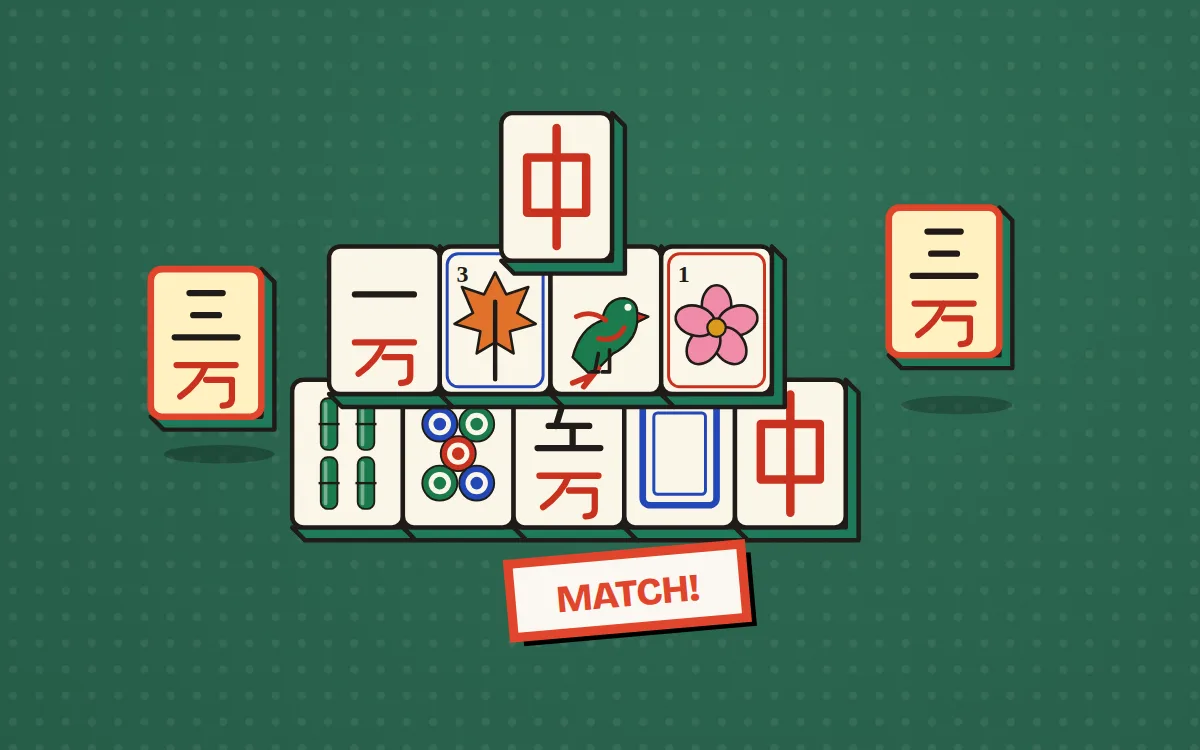
A Mahjong set looks like a wall of unfamiliar symbols until you see how it is organised. There are only three number suits, two kinds of honor tiles and two bonus groups. This guide names every tile, shows how to tell them apart, and explains which ones match in Mahjong Solitaire.
8 min readUpdated By PlayNest team
The 144 tiles at a glance
A full Mahjong set has 144 tiles, and they fall into seven groups. Three of them are number suits (circles, bamboo and characters) with tiles numbered 1 to 9. Two are honor tiles (winds and dragons). The last two are bonus tiles (flowers and seasons).
Count them and the total adds up neatly. Each of the 27 number tiles comes in four copies, which makes 108. Four winds, each in four copies, make 16. Three dragons, each in four copies, make 12. Four flowers and four seasons, one copy each, make 8. That is 108, 16, 12 and 8, which is 144.
In Mahjong Solitaire you play with these same tiles, one player at a time. You can try them in the Mahjong Solitaire game, where the Turtle layout uses all 144. For tips on playing them, see our Mahjong Solitaire strategy guide.
- Circles, 1 to 9: 36 tiles
- Bamboo, 1 to 9: 36 tiles
- Characters, 1 to 9: 36 tiles
- Winds, 4 kinds: 16 tiles
- Dragons, 3 kinds: 12 tiles
- Flowers, 4 kinds: 4 tiles
- Seasons, 4 kinds: 4 tiles
Circles (dots): count the discs
The circles suit is the easiest to read, because the number on the tile is simply the number of discs. A tile with five discs is a five of circles. In Chinese the suit is called tong, and in English you will also hear it called dots, coins or pins.
The one of circles is a single big disc, often drawn like a flower or a target, and it is one of the most decorative tiles in the set. On our tiles, the discs are ringed in blue, green or red, but the number is always the count, so you can ignore colour if you like.
Tip
If you struggle to count discs on small tiles, switch to the Clear tile style in our game. It puts the number in the corner of every number tile.
Bamboo: count the sticks, and meet the bird
The bamboo suit shows sticks, and again the number of sticks is the number of the tile. In Chinese this suit is called tiao, which means a stick or a string of coins. The sticks are usually green, with some red ones mixed in for decoration on the five, seven and nine.
The one of bamboo breaks the rule. It is not a stick but a small bird, traditionally a sparrow or a peacock depending on the set. Many new players do not realise it belongs to the bamboo suit, so look for the bird when you are hunting for ones. On our tiles it is drawn as a green bird with a red wing.
Characters: a number above the character for ten thousand
The characters suit is the one that looks most foreign to new players. Each tile shows a Chinese numeral in the upper half and the character for ten thousand in the lower half. In Chinese the suit is called wan. Only the top symbol changes from tile to tile, so you can learn the numerals once and read the whole suit.
The numerals from one to three are just that many horizontal strokes. Four looks like a small box with strokes inside it, five is a sort of crossed shape, six looks like a roof with legs, seven is a horizontal stroke with a hook, eight is two strokes leaning apart, and nine is a hooked shape. The bottom symbol, the same on every tile, is drawn in red. We draw its simplified form so that it stays clear at small sizes.
- 1, 2, 3: one, two or three horizontal strokes
- 4: a small box with strokes inside
- 5: a crossed shape with a base stroke
- 6: a dot, a bar and two spreading legs
- 7: a horizontal bar with a hook
- 8: two strokes leaning apart
- 9: a hooked stroke with a slanting stroke
Winds: east, south, west and north
The four winds are East, South, West and North, and there are four copies of each. In a four-player game they matter a great deal for scoring, because each player is assigned a seat wind. In solitaire they are just tiles that match their own kind.
Traditional wind tiles show a single Chinese character for each direction. To keep them readable on a phone, our tiles use the English letters E, S, W and N inside a ring, with a small red tick on the side of the ring that points the way, so the four are easy to tell apart.
Dragons: red, green and white
The three dragons are the other honor tiles, again with four copies of each. The red dragon shows the Chinese character zhong, which looks like a box with a line through the middle, drawn in red. The green dragon is traditionally the character fa, drawn in green. The white dragon is usually a blank tile, often with a blue frame, and in some old sets it is truly empty.
On our tiles the red dragon is the red character, the white dragon is the blue frame, and the green dragon is a green flame emblem that is easier to recognise at small sizes. If you only remember one thing, remember this: the three dragons are red, green and white, and they match only their own colour.
Flowers: plum, orchid, chrysanthemum and bamboo
The flower tiles are the first of the two bonus groups. There are four, each with its own picture: the plum blossom, the orchid, the chrysanthemum and a bamboo stalk. In Chinese culture these are known together as the four gentlemen, each standing for a quality such as endurance or modesty.
In four-player Mahjong, flowers are bonus tiles that are set aside and give points. In Mahjong Solitaire they are playable, and the rule is generous: any flower matches any other flower. Because there are only four of them, there are only two flower pairs on the whole board. Each flower is numbered 1 to 4 in the corner.
Seasons: spring, summer, autumn and winter
The seasons are the second bonus group, four tiles in all: spring, summer, autumn and winter. On our tiles they are drawn as a green sprout, a bright sun, a maple-style leaf and a snowflake, each numbered 1 to 4 in the corner and framed in blue so they are easy to tell from the red-framed flowers.
Again the solitaire rule is that any season matches any other season. A season does not match a flower, even though both groups are bonus tiles. If you have a flower and a season free and no other matches, that is not a pair.
Which tiles match in Mahjong Solitaire?
Matching is simpler than the tile set makes it look. Two tiles match if they are the same tile. That covers every number tile, every wind and every dragon: a five of bamboo matches another five of bamboo, and a red dragon matches another red dragon.
The two exceptions are the bonus groups. Any flower matches any flower, and any season matches any season. Everything else must be an exact copy. A one of circles never matches a one of bamboo, even though both are ones.
- Number tiles: match the same suit and the same number.
- Winds: match the same direction.
- Dragons: match the same colour.
- Flowers: match any other flower.
- Seasons: match any other season.
Tips for reading tiles quickly
Start by naming the suit, then the number. Circles and bamboo give you the number by counting. Characters give it by the top numeral. The honors are the tiles that have no number at all, so they are easy to spot because they look different.
Colour helps but should never be the only clue. Several suits share green and red. If colours are hard to tell apart, the Clear tile style in our game is built for that: it uses a blue, orange and black palette and adds a number and a small suit shape to the corner of every number tile, so you can read each tile by shape alone.
Tip
Zoom in on a small phone. The plus button on the board makes every tile larger, and Fit takes you back to the whole table.
From the tiles to the game
Once you can name the seven groups, the rest is practice. Begin with the Easy layout, which has only 36 tiles, and notice which tiles come up. Work up to Pyramid and finally the full Turtle. The tiles you see most are the number tiles, and the honors and bonus tiles become familiar quickly.
Ready to try? Play Mahjong Solitaire free in your browser, with all tiles drawn on the page and no download. If you enjoy games that reward planning ahead, our chess rules for beginners are a good next read.
Questions people ask
- How many tiles are in a Mahjong set?
- A full set has 144 tiles: 108 number tiles, 16 winds, 12 dragons, 4 flowers and 4 seasons. Some four-player games leave out the flowers and seasons and use 136, but Mahjong Solitaire normally uses all 144 on the Turtle layout.
- What are the three suits in Mahjong?
- The suits are circles (also called dots), bamboo and characters. Each has tiles numbered 1 to 9 with four copies of each number. The honor tiles, winds and dragons, are not part of any suit.
- Which Mahjong tiles match in solitaire?
- Identical tiles match, and any flower matches any other flower, and any season matches any other season. A flower does not match a season, and tiles of different suits never match, even if the numbers are the same.
- Why is the one of bamboo a bird?
- By tradition the single bamboo tile shows a bird, often a sparrow, instead of one stick. It is easy to miss, so look for the bird when you are searching for ones.
- Is there a colour-blind friendly way to read the tiles?
- Yes. The Clear tile style in our game uses high contrast colours and puts the number and a suit shape in the corner of each number tile. Every tile can be told apart by shape and number alone.