RulesChess
Chess rules for beginners, special moves included
Everything a beginner needs to play a full, legal game of chess: the setup, every piece, the three special moves, how to win and the ways a game ends in a draw.
5 min readUpdated By PlayNest team
The board and the setup
Chess is played by two players, White and Black, on a board of 64 squares in eight rows and eight columns. Rows are called ranks, numbered 1 to 8 from White's side. Columns are called files, lettered a to h from White's left. Every square has a name, like e4.
Set the board so each player has a light square in the bottom-right corner. Then place the pieces:
- Rooks in the corners, knights beside them, bishops beside the knights.
- The queen on her own colour: the white queen on the light square d1, the black queen on the dark square d8.
- The king on the remaining square next to the queen, e1 for White and e8 for Black.
- Eight pawns on the second rank in front of the pieces.
Tip
In our chess game the board is always set correctly, and you can switch on coordinates to learn square names as you play.
How each piece moves
White moves first, then the players take turns, one move each. A piece captures by moving onto a square held by an enemy piece, which is removed. You can never capture your own pieces, and only the knight can jump over others.
- King: one square in any direction. It may never move onto a square the opponent attacks.
- Queen: any number of squares in a straight line along a rank, file or diagonal.
- Rook: any number of squares along a rank or file.
- Bishop: any number of squares diagonally, so it stays on one colour all game.
- Knight: an L shape, two squares in one direction and one to the side. It jumps over anything in the way.
- Pawn: one square straight forward, or two from its starting square. It captures one square diagonally forward, never straight ahead, and never moves backward.
Special move 1: castling
Castling is the only move where two pieces move at once. The king moves two squares toward a rook, and that rook jumps to the square the king passed over. Castling kingside is written O-O; queenside is O-O-O. It tucks your king away and brings a rook toward the centre.
You may castle only when all of these are true:
- Neither the king nor that rook has moved earlier in the game.
- Every square between them is empty.
- Your king is not in check.
- The king does not pass through or land on a square the opponent attacks.
Special move 2: en passant
En passant, French for in passing, is a special pawn capture. If an enemy pawn moves two squares forward from its starting square and lands right beside your pawn, your pawn may capture it as though it had moved only one square. Your pawn moves diagonally onto the square the enemy pawn skipped, and the enemy pawn is removed.
You must do it on the very next move. If you wait, the chance is gone. Many beginners never learn this rule, so it is worth practising; our game shows en passant as a legal move when it is available.
Special move 3: promotion
A pawn that reaches the far end of the board must be promoted to a queen, rook, bishop or knight of the same colour. Usually you choose a queen, the strongest piece, which is why players say queening a pawn. You can have more than one queen.
In our game a small picker pops up over the board when a pawn promotes. If you always want a queen, switch on auto-queen in settings to skip the picker.
Check, checkmate and stalemate
A king that is attacked is in check. The player in check must get out of it immediately, in one of three ways: move the king to a safe square, capture the attacking piece, or put a piece between the attacker and the king. A move that leaves your own king in check is illegal.
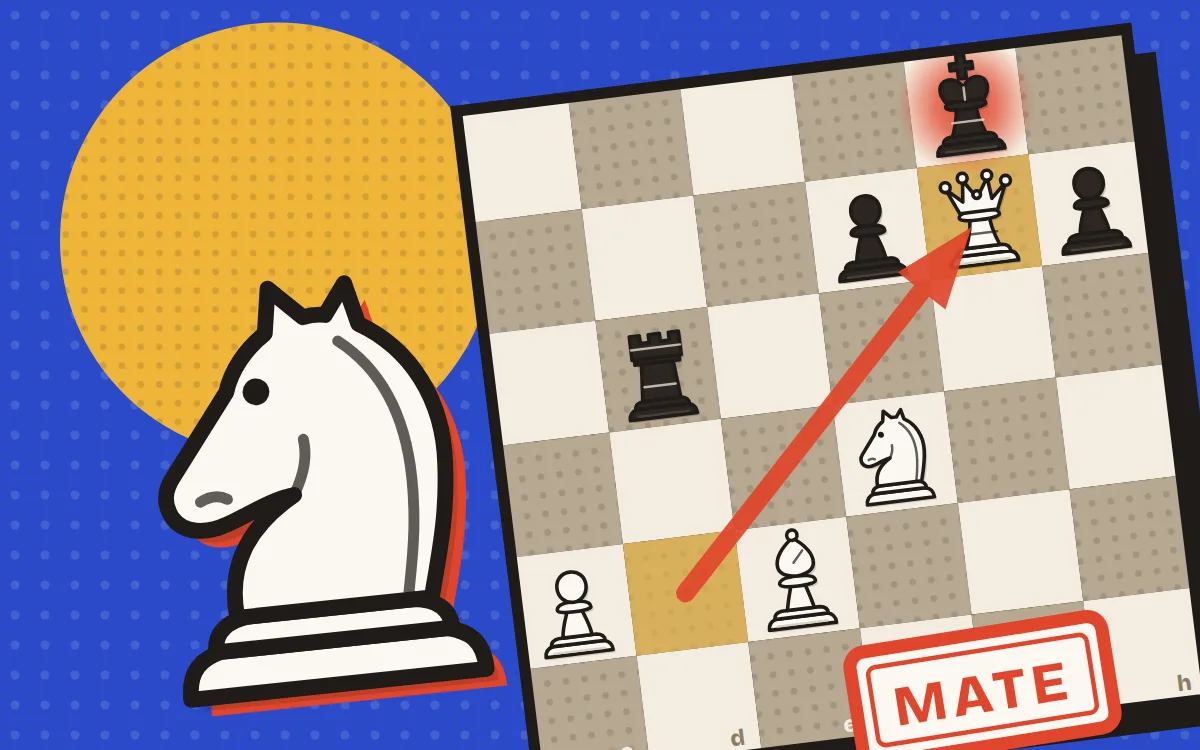
Checkmate is check with no way out, and it wins the game. The word comes from the Persian shah mat, the king is helpless; see Shatranj, the ancestor of chess for the story.
Stalemate is the opposite trap: the player to move is not in check but has no legal move. Stalemate is a draw, not a win, so when you are far ahead, be careful not to box in a lone king without giving check.
Every way a game can be drawn
Not every game has a winner. A game is drawn by:
- Stalemate.
- Threefold repetition: the same position, with the same player to move, appears three times.
- The fifty-move rule: fifty moves by each side with no capture and no pawn move.
- Insufficient material: neither side can possibly checkmate, such as king against king, or king and bishop against king.
- Agreement: one player offers a draw and the other accepts.
- Time: if your clock runs out but your opponent has no possible way to checkmate, it is a draw instead of a loss.
How to start playing
Learn the moves, then play. Our chess game shows legal moves as dots and captures as rings, so you cannot make an illegal move by accident. Start against Bilal, the beginner computer level, and work up through eight levels. When you can beat the first few, read opening principles and the three checkmate patterns every beginner should know.
Questions people ask
- Who moves first in chess?
- White always moves first. After that the players alternate, one move each.
- Can a pawn move backward?
- No. Pawns only move forward: one square, or two from their starting square. They capture one square diagonally forward.
- Is stalemate a win?
- No. Stalemate, where the player to move has no legal move but is not in check, is a draw.
- Can you castle out of check?
- No. You cannot castle while in check, and the king may not pass through or land on an attacked square.
- What is en passant in simple words?
- If an enemy pawn jumps two squares and lands beside your pawn, you can capture it as if it had moved one square, but only on your very next move.