Skip to content
اردو
BRD: Board Games

Mensch ärgere dich nicht

BoardMultiplayerEasy~20 min

Ready to play · free

The German classic for 2 to 4 players: one die, a 6 to come out, compulsory captures and no safe squares. Play the computer or friends online.

Play now2–4 players · vs computer or friends

Rate this game

Be one of the first to rate it.

Game info

Developer
PlayNest Studio
Released
Last updated
Platforms
Browser, Android, iPhone, PC
Players
2–4 players, vs computer or friends
Average play time
~20 min per round
Languages
English, Urdu
Controls
Keyboard or mouse on computers, touch on phones and tablets
01

How to play

  1. Roll a 6 to bring a piece out onto your start square, then roll again. With all pieces at home you get three tries.
  2. Move one piece clockwise by the number rolled. You may jump over pieces but never land on your own.
  3. Capturing is compulsory when you can, and a piece on your start square must move before anything else.
  4. There are no safe squares. Enter your four home squares with exact rolls: the first player to fill them wins.
02

Controls

Keyboard & mouse

Space
Roll the die
Click
Move a highlighted piece

Touch

Tap
Tap your dice box to roll, then a highlighted piece
03

About

Mensch ärgere dich nicht, the German classic, for 2 to 4 players. One die, four pieces each, a 6 to come out, another roll after every 6, compulsory captures and no safe squares. Play Easy, Smart or Hard computers, 2 to 4 players on one screen, or friends online by room code or WhatsApp link, with the house rules switchable one by one.Also known as Mensch ärgere dich nicht, Mensch aergere dich nicht, Mensch ärgere Dich nicht online, Ärgere dich nicht, Aergere dich nicht, MÄDN, MAEDN, Mensch ärgere dich nicht spielen, Mensch ärgere dich nicht kostenlos, Mensch ärgere dich nicht Regeln, Mensch ärgere dich nicht mit Freunden, Mensch ärgere dich nicht gegen den Computer, Don't get annoyed, Don't worry, be happy game, German Ludo, Man, don't get angry, Sorry-style race game, Ludo with forced captures, Schlagzwang, Mensch ärgere dich nicht 4 Spieler.

04

Tips & tricks

  • With no safe squares, stay out of the six squares in front of an opponent's piece.
  • Use the compulsory capture: leave a piece as bait so their piece lands where you can hit it back.
  • Keep your start square clear and push the first piece to the deepest home square.

Mensch ärgere dich nicht: complete guide

Mensch ärgere dich nicht (often MÄDN, or just Ärgere dich nicht) is the German-speaking world's favourite dice race: four players, one die, four pieces each, a 6 to come out and a very annoying rule that you must capture whenever you can. Play Mensch ärgere dich nicht online free here, against Easy, Smart or Hard computers, with 2 to 4 players on one screen, or with friends by room code or WhatsApp link, using the usual German rules with no safe squares. No download and no sign-up.

How to play Mensch ärgere dich nicht online

Choose 2, 3 or 4 players, type your name and press Play vs computer. Each player has four pieces waiting in the house, the coloured corner of the board. On your turn you roll the die by tapping your dice box in your corner (or pressing Space). The pieces you can move glow, and you tap one to move it. With one die and a single useful move the game plays it for you if Auto-move is on.

The aim is to bring all four of your pieces once around the 40-square board and into your four home squares, the coloured lane that points at the centre. The first player to fill all four home squares wins. You can also play on for second and third place by switching Quick game off.

  • Roll a 6 to bring a piece out onto your start square, then roll again.
  • Move one piece clockwise by the number rolled. You may jump over other pieces.
  • Land exactly on an opponent to send that piece back to its house.
  • Capturing is compulsory when you can, and you must clear your start square before anything else.
  • Enter your home squares with the exact number and fill all four to win.

Mensch ärgere dich nicht rules: the board and the goal

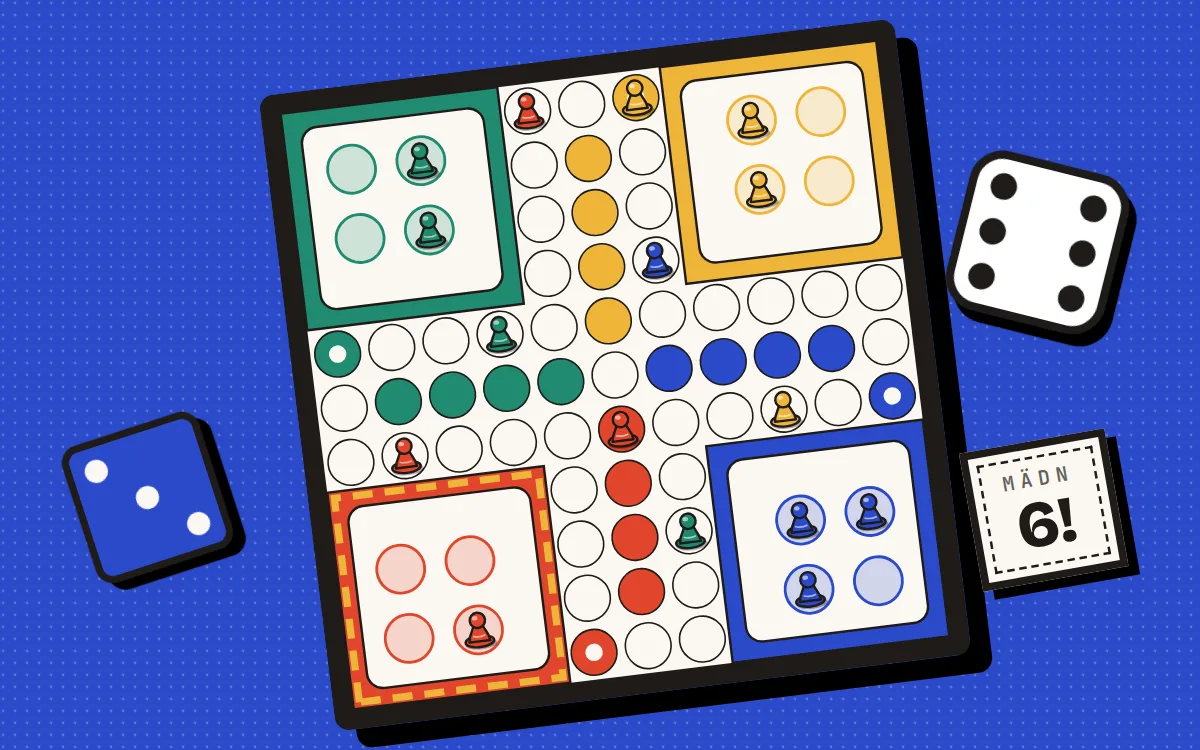
The board is a cross. Around the outside runs a ring of 40 squares that every colour shares. Each player owns one corner (the house, where the pieces start), one start square on the ring, and a coloured lane of four home squares leading from the edge of the ring toward the middle. In our game the player at the bottom is red, then green, yellow and blue go round the table clockwise.

A piece travels clockwise from its start square all the way round the ring, which is 40 squares in all counting the start square, and then turns off into its own home squares instead of going past the start square again. The four home squares are filled from the back: the first piece to get in can go to the deepest square, and the others stop in front of it. All four pieces must end up inside the lane. There is no centre square to reach and nothing to roll for once your pieces are packed in.

How do you get a piece out? The 6 and the three tries

A piece can only leave the house with a 6. It comes out onto your start square, and because every 6 gives another roll you immediately roll again. When all four of your pieces are in the house you do not have to wait a whole round for a 6: you get up to three rolls in a row to throw one. After three misses the turn passes to the next player. The same three tries apply when your pieces are not in the house but are parked at the very back of your home squares and cannot move, because from outside the table that looks exactly the same as having nothing to play.

As soon as one of your pieces is on the board, the three tries stop. With a piece to move, a roll that is not a 6 is simply used by that piece, and the turn passes when you have moved. You can switch three tries off in the house rules if your family plays one roll per turn.

What are the forced moves in Mensch ärgere dich nicht?

This is the part that gives the game its name. Several moves are compulsory, and when more than one rule applies they are checked in this order of priority.

  • First, clear your start square. If you still have pieces in the house and one of your own pieces is standing on your start square, that piece must move, because otherwise nobody could come out. If it cannot move (for example it would land on another piece of yours) the next rule applies.
  • Second, leave the house on a 6. If you roll a 6 and there is a piece in the house and the start square is free, you must bring a piece out.
  • Third, capture if you can. If any legal move lands on an opponent's piece, you must make a capturing move. This is called Schlagzwang, the compulsory hit, and it is why the game is famously annoying: you cannot keep a piece safe by simply not hitting.
  • Otherwise you may choose any legal move.

Can you capture, and are there safe squares?

Yes, and there are no safe squares at all, not even the coloured start squares. If your piece ends its move exactly on a square where an opponent's piece stands, that piece goes back to its owner's house and your piece takes its place. There are no bonus rolls for capturing in the usual German rules, so the only reward is the setback you cause. A piece coming out of the house with a 6 captures an opponent standing on your start square in the same way, which makes hovering on someone else's start square a risky habit.

You may never land on a square occupied by one of your own pieces. You can jump over any piece, yours or an opponent's, on the ring, so pieces never block each other. Inside your home squares you can only move forward into free squares and you may not jump over your own pieces there.

How do the home squares work? Exact entry

After a full lap a piece turns into your home squares. You need an exact count: the lane has four squares, and a roll that would take a piece past the last one cannot be used by that piece. A piece standing at the last ring square before the lane can use a 1 to step into the first home square, a 4 to reach the deepest one, and nothing higher. Pieces that are already inside can still step forward if the square ahead is free, so a 1 can shuffle a piece from the second square to the third.

This is why the end of the game is slow and tense: you often need a specific number, and with three pieces parked and one outside you can wait many turns. It also explains the three tries. If every piece you own is in the house or parked at the back of the lane, you are effectively waiting for a 6 or a lucky small number, so the game lets you roll again.

How many people can play Mensch ärgere dich nicht?

The board is made for four, and we let 2, 3 or 4 sit down. With two players you can choose opposite corners or side-by-side corners. Empty seats are played by the computer. Online, up to three friends can join your room with a link or a room code, and any seats they do not take are still computers. The voice chat button and emoji chat are there for the shouting that this game always produces.

Playing with friends: press Invite friends, send the link on WhatsApp or copy it, and wait for everyone to appear in the lobby. You can also play quick match with strangers from the setup screen. Hosts choose the house rules, and joiners see them in the lobby before the game starts.

Mensch ärgere dich nicht strategy: how to win

Do not rush pieces onto the board without a plan. Because there are no safe squares, a lone piece is always in danger from any opponent up to six squares behind it. Before you move, count the pieces behind each of your pieces and ask how many numbers would hit you. A piece with an opponent one to six squares behind is in danger, and your risk on a single roll is about one in six for each opponent piece that is in range.

Use the forced capture to your advantage. If you know an opponent must capture you, you can leave a piece as bait to drag their piece into the open where your next piece can recapture. Keep your own start square clear before you are forced to, and try not to put two pieces where a capture will always be available to somebody else.

Get home squares filled in the right order. Move the first piece to the deepest home square, not the first one you reach, if the choice exists, because pieces parked at the front of the lane block those behind them from using small numbers. And do not leave your last piece waiting on the ring: the exact count means it may need several turns, so start the final approach early when the lane is free.

Against the Hard computer, expect it to take every capture and to avoid squares just in front of your pieces. It looks one move ahead at what the next player could roll, so playing safe and waiting for a good roll is often better than running.

House rules and variants of Mensch ärgere dich nicht

Families have always argued about the details, so we let you switch the main ones. In the House rules button you can turn the three tries on or off, make clearing the start square, leaving on a 6 and capturing compulsory or optional, play on for places or end the game at the first winner, pick who starts, and add a turn timer of 15 or 30 seconds. The how to play button always shows the rules exactly as they are set.

Other versions you may know: in Ludo you need a 6 as well but there are safe squares and capturing is not forced. In Parchís two dice are used and there are barriers. In Petits chevaux the board has 56 squares and a central square at the end. The Swedish game Fia med knuff and the American Sorry follow the same idea. All of them descend from the Indian race game Pachisi. See our comparison of Ludo, Mensch ärgere dich nicht, Parchís and Petits chevaux for the differences.

A short history of Mensch ärgere dich nicht

The game is traditionally credited to Josef Friedrich Schmidt, a Munich teacher who made it for his children in the first years of the twentieth century and began selling it around 1910. During the First World War large numbers of copies were sent to soldiers as a way of passing time, which helped it spread across Germany and beyond. Today it is played in Germany, Austria and Switzerland, and under other names in many other countries. The name means roughly Man, don't get angry, which is good advice that nobody follows.

Mensch ärgere dich nicht online spielen: Hinweise auf Deutsch

Mensch ärgere dich nicht kostenlos online spielen: Hier spielst du Mensch ärgere dich nicht gegen den Computer oder mit Freunden per Link, ohne Download und ohne Anmeldung. Es gelten die bekannten Regeln: Man braucht eine Sechs, um eine Figur aus dem Haus zu setzen, bei jeder Sechs darf man nochmal würfeln, und wer mit seinem Zug eine fremde Figur schlagen kann, muss das tun (Schlagzwang). Das Startfeld muss geräumt werden, sobald noch Figuren im Haus stehen. Wenn alle Figuren im Haus sind, hat man bis zu drei Versuche, eine Sechs zu würfeln. Es gibt keine sicheren Felder, und in das Zielhaus kommt man nur mit der genauen Augenzahl. Wer zuerst alle vier Figuren im Ziel hat, gewinnt. Mit den Hausregeln kannst du Schlagzwang, drei Würfe und Startzwang einzeln ein- und ausschalten. Die Regeln findest du jederzeit unter So wird gespielt.

05

Mensch ärgere dich nicht FAQ

Is Mensch ärgere dich nicht free to play?
Yes. Mensch ärgere dich nicht is completely free on PlayNest. There is nothing to buy and no account to create.
Do I need to download Mensch ärgere dich nicht?
No. Mensch ärgere dich nicht runs in your web browser, so you can start playing straight away on Chrome, Safari, Edge or Firefox.
Can I play Mensch ärgere dich nicht on my phone?
Yes. Mensch ärgere dich nicht works on Android phones, iPhones, tablets and computers, with touch and keyboard controls.
How many players can play Mensch ärgere dich nicht?
You can play against the computer, or create a room and share the link to play Mensch ärgere dich nicht online with friends.
How long does a game of Mensch ärgere dich nicht take?
A round takes about 20 minutes. It is rated easy and sits in our Board Games collection.
How do you play Mensch ärgere dich nicht?
Each player has four pieces in the house. Roll a 6 to bring one out onto your start square and roll again. Move one piece clockwise by the number rolled, capture opponents by landing exactly on them, and bring all four pieces into your home squares with exact rolls. The first player with all four home wins.
Do you have to capture in Mensch ärgere dich nicht?
Yes, in the usual German rules capturing is compulsory (Schlagzwang). If any move you can make lands on an opponent's piece, you must make one of those capturing moves. Our game follows this by default, and you can switch it off in the house rules if your family plays with a free choice.
How many tries do you get to roll a 6?
When every one of your pieces is in the house, or parked at the back of your home squares and unable to move, you get up to three rolls per turn to throw a 6. After the third miss the turn passes. As soon as a piece is on the board, you only roll once per turn. The three tries can be switched off.
What happens if your own piece is on your start square?
If you still have pieces in the house, the piece on your start square must move before anything else, so that other pieces can come out later. If it cannot move because the landing square holds another of your own pieces, you may choose another legal move. This rule has priority over bringing a new piece out.
Are there safe squares in Mensch ärgere dich nicht?
No. No square on the ring is safe, including the start squares. A piece that leaves the house with a 6 even captures an opponent standing on your start square. The only protection is distance: stay out of the six squares in front of an opponent's piece, or keep your pieces where they cannot be reached.
Do you need an exact roll to get home?
Yes. The home lane has four squares and a piece can only enter and move forward with a count that fits. A roll that would carry a piece beyond the last home square cannot be used by that piece. You can also step forward inside the lane when the next square is free. You may not jump over your own pieces there.
Can I jump over other pieces?
Yes, on the ring you can jump over any pieces, yours or an opponent's. There are no blockades in Mensch ärgere dich nicht. The restriction is only that you cannot land on a square holding one of your own pieces, and inside your home squares you cannot jump over your own pieces.
Do I get another roll for capturing or getting home?
No. In the common German rules only a 6 gives another roll. Capturing and reaching the home squares give no bonus. If you like bonus rolls, those belong to Ludo, where captures and reaching home both give an extra turn, or to Parchís, which gives bonus moves of 20 and 10.
Can I play Mensch ärgere dich nicht against the computer?
Yes. Choose Easy, Smart or Hard computers. Easy plays mostly at random, Smart scores each move for captures, danger and progress, and Hard also looks at what the next player could roll after your move. With 2, 3 or 4 players, the seats you do not fill are played by the computer.
Can I play Mensch ärgere dich nicht online with friends?
Yes. Press Invite friends, send the link on WhatsApp or copy it, and up to three friends can join without installing anything. You can also use the room code, and chat or voice chat while you play. Seats nobody takes are played by the computer, and there is a quick match button for finding a table with other players.
Is Mensch ärgere dich nicht the same as Ludo?
They are cousins. Both use a cross-shaped board, a 6 to come out, and a race home. Mensch ärgere dich nicht has 40 squares, compulsory captures, no safe squares and no extra rolls for captures, while Ludo usually has 52 squares, safe star squares and bonus rolls. Our Ludo game also lets you add house rules.
Who wins if nobody can finish?
The game ends when a player fills all four home squares. If you turn Quick game off, play continues for second and third place until only one player is left, and anyone who cannot move simply waits. Every game has a winner because pieces keep moving and getting captured, so the game always makes progress.
Is it free and does it work on a phone?
Yes, Mensch ärgere dich nicht is free to play in your browser on phones, tablets and computers. There is nothing to download. You can play with touch, mouse or keyboard, and the board scales from small phones to wide desktop screens. Your settings are remembered on your device.
06

You might also like

More Board Games