ComparisonLudo
Ludo vs Ludo King vs Parcheesi vs Pachisi: what is the difference?
Four names that get used as if they were one game. One is an ancient Indian game, two are simplified versions of it, and one is an app. Here is how they really compare.
4 min readUpdated By PlayNest team
The family tree in one paragraph
Pachisi is the original: a cross-and-circle race game from the Indian subcontinent, played for centuries with cowrie shells instead of dice. Parcheesi is an American branded version from the nineteenth century. Ludo is the simplified British version from the same period, with one die and a square board, and it is the one most families in Pakistan and India play today. Ludo King is not a separate game at all: it is a popular mobile app that plays Ludo.
Pachisi: the ancient original
Pachisi is usually played on a cloth board shaped like a cross, by four players in two teams, with partners sitting opposite. Instead of dice, players throw cowrie shells and count how many land mouth up. The highest throw is 25, pachis in Hindi and Urdu, which gives the game its name.
Pieces start in the centre, travel down their own arm of the cross, round the whole board and back up to the centre. Certain squares, marked with crosses, are safe. Mughal emperor Akbar is famously said to have played it on a life-size courtyard board at Fatehpur Sikri. A close relative, Chaupar, uses long four-sided dice and is often played the same way.
Parcheesi: the American brand
Parcheesi is a trademarked American adaptation that has been sold since the nineteenth century. It uses two ordinary dice, and each die can move a different pawn. A pawn enters the board on a roll of 5. The track is longer than Ludo's, with twelve safe spaces, and two pawns of one colour on a square form a blockade that nobody can pass.
It also has bonuses Ludo does not: capturing an opponent lets you move one pawn twenty extra spaces, and getting a pawn home earns ten. Rolling doubles gives another turn, but three doubles in a row sends a pawn back. Parcheesi is a little slower and more tactical than Ludo, mainly because of the two separate dice and the blockades.
Ludo: the simple version most of us play
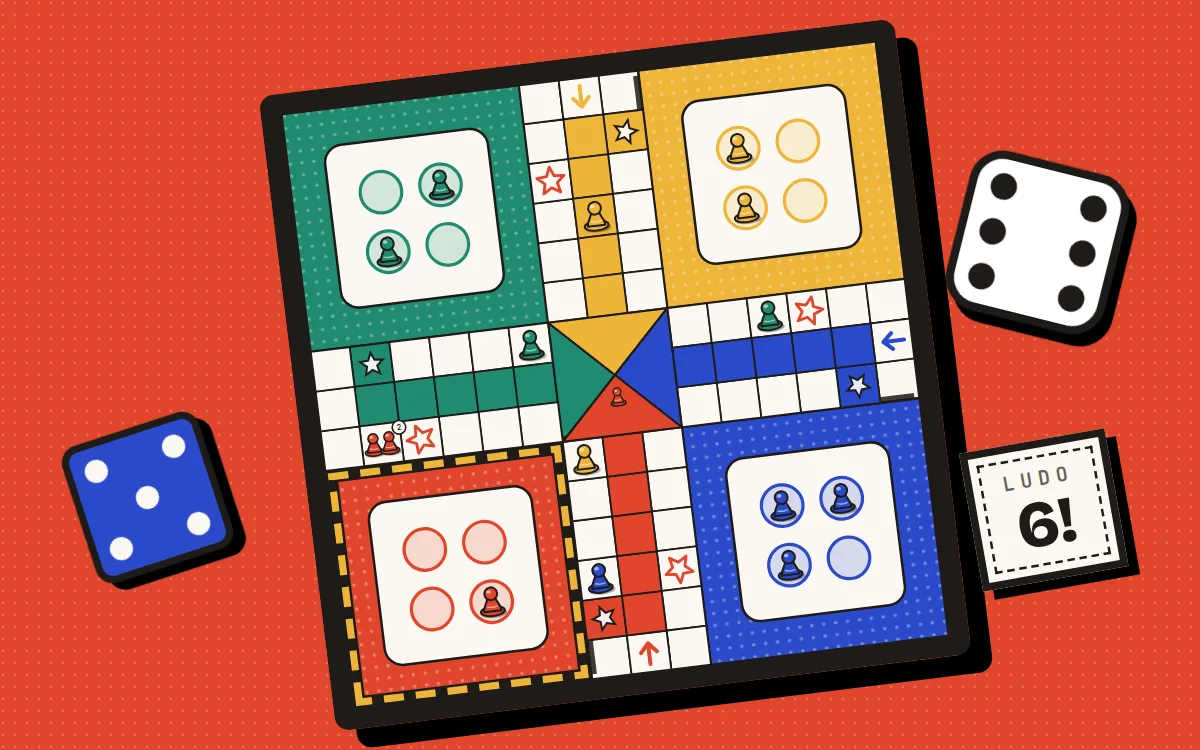
Ludo keeps the cross-shaped race but strips it down: one die, a square board with a coloured yard in each corner, four tokens (gotis) per player, and a 6 to come out. Land exactly on an opponent and you send it home. A 6 gives another roll, and three 6s cancel the turn. Star squares and start squares are safe.
Because Ludo spread from home to home, it gathered house rules everywhere: 1 or 6 to come out, kill to unlock home, blockades, team play and many more. Our Ludo game lets you switch each of them on or off, and Ludo rules explains every one.
Ludo King: an app, not a new game
Ludo King is a mobile game developed in India that became hugely popular across South Asia, especially during the 2020 lockdowns when families could not meet. It plays Ludo with its own default rules and adds online matchmaking, private rooms, themes and extra modes.
It is a commercial app: you install it, and it is supported by advertising and in-app purchases, with online matches built around an in-game coin system. None of that changes the game itself. If you know how to play Ludo, you know how to play Ludo King.
How our Ludo compares
We built our Ludo for people who want the game without the extras. It runs in a browser tab on phones and computers, with nothing to install, no account, no coins and no adverts between turns. You can play against Easy or Smart computer players, or open a room and send the link to friends; see how to play Ludo with friends on WhatsApp.
Where we go further is the rules. Instead of one fixed version, every popular house rule is a switch: how you get out, safe squares, blockades, kill to unlock home, exact finish, quick game, team play, 1 to 3 dice and 1 to 4 gotis.
Side by side
The quick comparison:
- Dice: Pachisi uses cowrie shells. Parcheesi uses two dice. Ludo uses one die. Ludo King uses one die.
- Getting out: Parcheesi needs a 5. Ludo and Ludo King normally need a 6.
- Bonuses: Parcheesi gives bonus moves for captures and for getting home. Ludo gives an extra roll instead.
- Teams: traditional in Pachisi, optional in Ludo.
- Where you play: Pachisi and Parcheesi on a board, Ludo on a board or online, Ludo King in its app.
Questions people ask
- Is Ludo the same as Pachisi?
- Ludo is a simplified version of Pachisi. Pachisi uses cowrie shells, a cross-shaped cloth board and teams; Ludo uses one die, a square board and is usually every player for themselves.
- Is Parcheesi the same as Ludo?
- They come from the same Indian original, but Parcheesi uses two dice, enters on a 5, has a longer track and gives bonus moves for captures and for reaching home.
- Is Ludo King a different game from Ludo?
- No. Ludo King is an app that plays Ludo, with its own default rules and features. The game is the same.
- Can I play Ludo online without installing an app?
- Yes. Our Ludo runs in your browser on phone or computer. Play the computer or send a room link to friends, with no download or account.