RulesLudo
Ludo rules: the complete guide, house rules included
The standard rules of Ludo, written clearly, followed by the house rules families argue about: 1 or 6 to get out, kill to unlock home, blockades, team play and more.
5 min readUpdated By PlayNest team
The board and the goal
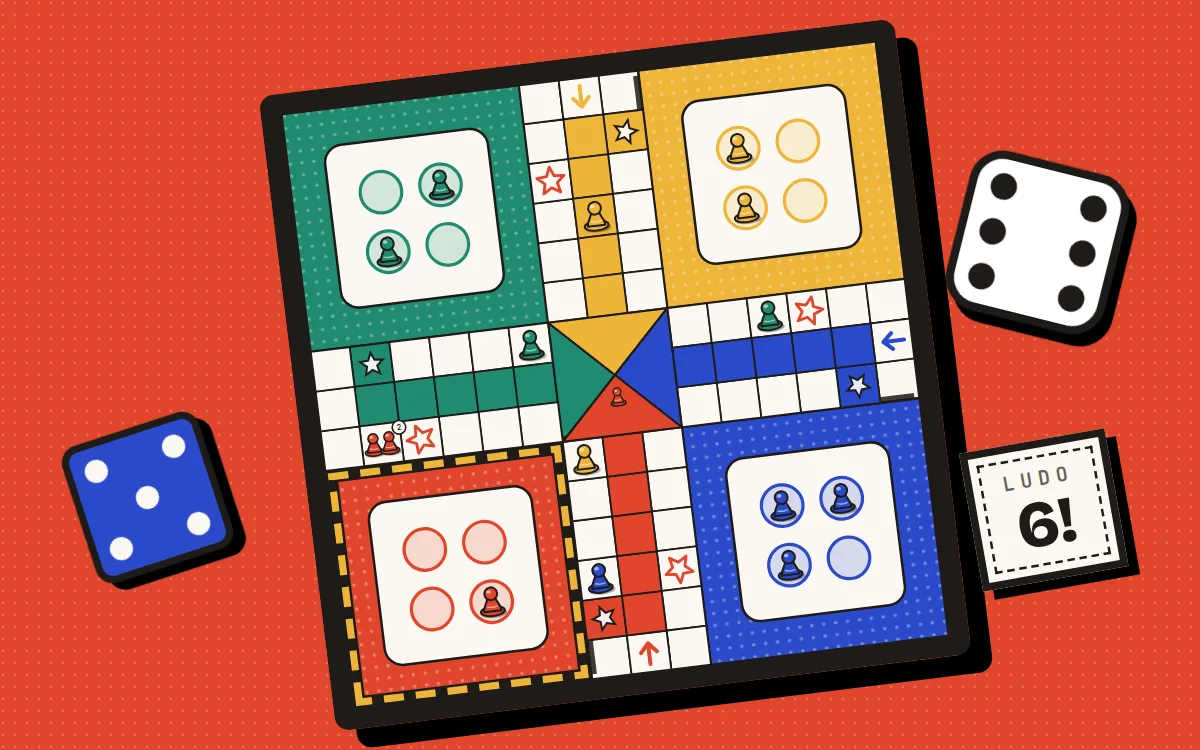
Ludo is played on a cross-shaped board by 2 to 4 players. Each player owns one coloured corner, the yard, where their gotis (tokens) wait at the start. Around the board runs a shared track of 52 squares. From each colour's start square, a coloured home column leads up into the centre.
Your goal is to move every one of your gotis once around the track, up your own home column and into the centre before anyone else does. The rules below are the defaults in our free Ludo game. After them comes a full list of house rules, because almost nobody plays Ludo exactly the same way.
Turns and getting a goti out
Players take turns rolling the die. Who goes first is random by default; you can also choose highest roll or let the host start.
You need a 6 to bring a goti out of the yard onto your coloured start square. Until you roll a 6, a player with every goti in the yard simply passes. Once you have gotis on the board, each roll moves one goti forward by the number shown, clockwise round the track.
If no goti can use the roll, for example because the only moves would overshoot home, the turn passes.
Extra turns and three 6s
Three things earn you another roll in the default rules:
- Rolling a 6.
- Cutting an opponent's goti.
- Getting one of your gotis home to the centre.
Tip
Three 6s in a row cancel the turn: the third 6 is not played and the next player rolls. Some families also send the goti moved last back home; that is a switchable house rule.
Cutting and safe squares
If your goti lands exactly on a square holding an opponent's goti, you cut it. The cut goti goes back to its yard and needs another 6 to come out. With our default rules, two opponent gotis on the same square are both cut; only the Blockades house rule turns a pair into a wall. Passing over an opponent does nothing; only an exact landing cuts.
Some squares are safe. Nobody can be cut on a coloured start square, or on one of the four star squares that sit eight squares along from each start. Two different colours can share a safe square peacefully.
- Example: your goti is 4 squares behind a red goti. You roll a 4, land on it and cut it. Red's goti returns to the yard and you roll again.
- If that red goti had been sitting on a star square, the move would still be allowed, but nothing would be cut.
The home column and finishing
After a full lap, your goti turns off the shared track into your own coloured home column. Opponents can never enter it, so a goti in the home column is completely safe.
You need the exact number to land in the centre. If you are three squares away, only a 3 takes the goti home. Bigger rolls must be used on another goti, or the turn passes.
The first player with every goti home takes first place. By default play continues for second and third, and the game ends when only one player is left on the board.
Setting up a game
In our game you choose 2, 3 or 4 players. In a 2-player game you also choose the seating: opposite corners, the classic way, or side by side. Every seat you do not fill with a person is played by the computer.
You also choose how many gotis each player gets, from 1 to 4, and how many dice to roll, from 1 to 3. With more than one die you can use each die as a separate move or add them together. One or two gotis make a quick game; four is the full traditional match.
Every house rule, explained
These are the house rules you can change in setup or in the online lobby before a game starts. Each one changes the game in a specific way.
- Roll to get out: 6 only (default), 1 or 6, or any roll. Easier entry means faster, more crowded games.
- Start with one goti out: each player begins with a goti already on the start square.
- 6 gives another roll: on by default.
- Three 6s: cancel the turn (default), optionally also send the last goti moved back to the yard, or switch the rule off.
- Capturing or reaching home gives another roll: both on by default.
- Doubles give another roll: with 2 or 3 dice, matching dice earn a re-roll.
- Safe start squares and safe star squares: each can be switched off for a more cut-throat game.
- Blockades: two gotis of one colour on a square form a wall that nobody else can pass, land on or capture.
- Captured gotis go to: the yard (default) or only back to their start square.
- Kill to unlock home: your gotis cannot enter the home column until you have cut at least one opponent; until then they keep circling.
- Exact roll to finish: on by default. Switch it off and any big enough roll takes a goti home.
- Quick game: ends as soon as the first player gets every goti home, with the rest ranked by distance travelled.
- Team play: with 4 players, opposite corners are partners.
- Turn timer: 15 or 30 seconds per turn, or none.
Team play rules
With team play on, the two players in opposite corners are partners. You cannot cut your partner's gotis, and your partner's blockades never block you. Once all your own gotis are home, you keep taking turns and move your partner's gotis instead. The team finishes together and shares the place.
Ready for tactics? Read Ludo winning strategy, and for the difference between a duel and a full table, 2-player vs 4-player Ludo.
Questions people ask
- Do you need a 6 to start in Ludo?
- In the standard rules, yes. Many families allow 1 or 6, or any roll, and our game lets you choose. You can also start with one goti already out.
- Can you cut a goti on a star square?
- Not with safe stars on, which is the default. Start squares are safe too. Both can be switched off in house rules for a rougher game.
- Do you need an exact roll to get home in Ludo?
- By default, yes. If you are three squares from the centre you need a 3. You can switch exact finish off so any big enough roll counts.
- What happens if you roll three 6s?
- The third 6 is cancelled and your turn ends. Some families also send the goti you moved last back to the yard, which you can switch on.
- How many people can play Ludo?
- Two to four. In our game the computer fills any seat not taken by a person, both offline and in online rooms.