StrategyLudo
Ludo winning strategy: how to beat luck with better choices
You cannot control the dice, but you choose which goti moves on every roll. These are the choices that win more Ludo games over an evening, with the odds behind them.
5 min readUpdated By PlayNest team
Where skill fits in a dice game
Every roll in Ludo is luck. What is not luck is the choice you make with it. With three or four gotis on the board, a roll of 4 might give you four different moves, and over a full game you make dozens of these choices. Players who choose well win noticeably more often, even though any single game can go either way.
This guide assumes the standard rules of our Ludo game. If you play with house rules such as kill to unlock home or blockades, the later sections show how they change things. For the rules themselves, see Ludo rules.
Know the danger distances
The single most useful thing to learn is how likely you are to be cut. Look backwards from your goti and count the squares to each opponent behind it.
- 1 to 6 squares behind you: the opponent needs one exact number, about a 1 in 6 chance on their roll, a little more because a 6 earns another roll.
- 7 to 12 squares behind: they need a 6 and then the exact remainder, about 1 in 36. Much safer.
- More than 12: very unlikely to reach you this turn.
- Several opponents within 6: the risks add up. Two gotis behind you within range is roughly a 1 in 3 chance.
Tip
When you have a choice, move the goti that ends its move with nobody 1 to 6 squares behind it, or onto a safe square.
Use safe squares as stepping stones
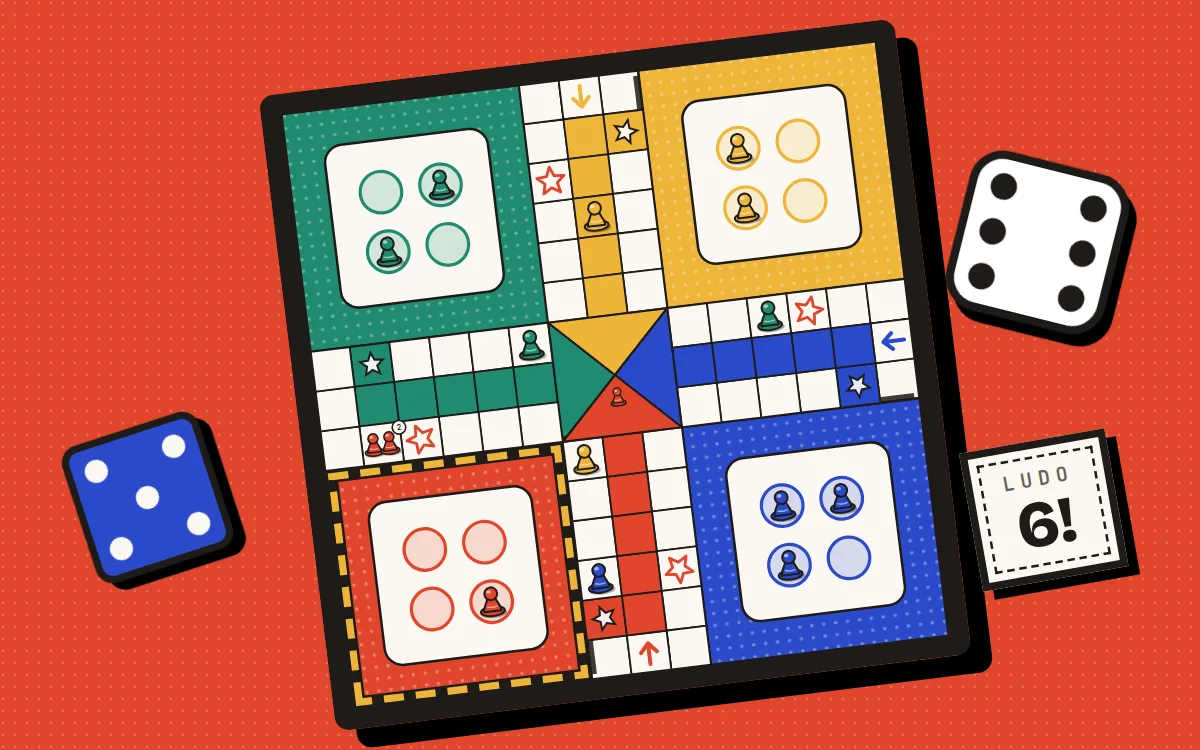
Start squares and the four star squares, eight squares along from each start, are safe by default. Nobody can cut you there. Think of them as stepping stones: it is often better to move a short distance onto a star than a long distance into open track with an opponent close behind.
Do not overstay, though. A goti parked on a star is safe but not progressing, and the gotis you move instead may be the ones taking the risk.
Get more than one goti out
With only one goti on the board, every roll must move it, even straight into danger. With two or three out, you can choose which one to move, and choice is where skill lives.
So when a 6 comes, bringing a new goti out is often better than running your lead goti further. The exception is when your lead goti is in danger and the 6 can carry it to safety or into the home column.
Cut the right goti
When you can cut, you usually should: it sends an opponent backward and earns you another roll. But when you have a choice of captures, cut the goti that has travelled furthest. Sending back a goti that is nearly home costs its owner far more than sending back one that has just come out.
Think about what happens after the cut, too. If cutting leaves your goti sitting just in front of two other opponents, you may lose it on the very next turn. Sometimes the bonus roll lets you move it on to safety; plan for that.
Respect the start squares
Each colour's start square is where its new gotis appear. If an opponent still has gotis in the yard and start squares are not safe in your rules, sitting on their start square is risky: the moment they roll a 6, their new goti lands on you.
With safe start squares on, which is our default, you cannot be cut there. But the squares just after an opponent's start are still exposed to their new gotis, so move through quickly.
Get into the home column
Once a goti enters your home column, nobody can touch it. So when a goti is close to turning in, getting it the last few squares into the column is often worth more than any other move.
Remember the exact-finish rule. Inside the column you need the precise number to reach the centre, so it is usually better to bring a goti into the column early and finish it later with a small number than to leave it waiting outside.
Tactics for popular house rules
Some house rules change what good play looks like.
- Kill to unlock home: your gotis cannot enter the home column until you have cut someone. Hunt early, while opponents are bunched near their starts, or your lead goti will circle the board exposed.
- Blockades: two of your gotis on one square form a wall. Building one just in front of a rival's lead goti can hold them up for several turns.
- Captured gotis go to the start square: cuts hurt less, so you can take more risks running forward.
- Several dice in separate mode: plan both moves before you tap. Use the small die to step onto safety and the large die to run.
- Team play: you cannot cut your partner and their walls never block you, so move to protect your partner's gotis by sitting behind threats.
How our computer players think
If you want a sparring partner, our Smart computer weighs the same ideas: it looks for captures, values cutting gotis that have travelled far, runs for safe squares and the home column, and avoids ending a move where enemies can reach it. The Easy computer moves almost at random, which is good for children.
Playing a few games against Smart and asking why it chose each move is a quick way to improve. When you are ready, invite friends; our guide to playing Ludo on WhatsApp shows how.
Questions people ask
- Is Ludo all luck?
- Each roll is luck, but you choose which goti to move. Over a whole game, better choices about safety, captures and timing win noticeably more often.
- How far away is safe in Ludo?
- More than six squares in front of an opponent is much safer: they would need a 6 and then the exact remainder. Within six squares they need only one exact number.
- Should I always cut when I can?
- Usually, because it sets an opponent back and gives you another roll. If you have a choice, cut the goti that has travelled furthest, and think about whether your goti will be safe afterwards.
- Is it better to bring out a new goti or move one forward?
- Having more than one goti on the board gives you choices, so bringing one out is often right. Move forward instead when the 6 can carry a threatened goti to safety or into the home column.