StrategyRung
How to choose trump in Rung from just five cards
You get one look at five cards and then you must name the trump for the whole round. Here is a simple, reliable way to make that call, with examples and the maths behind it.
5 min readUpdated By PlayNest team
Why the call matters so much
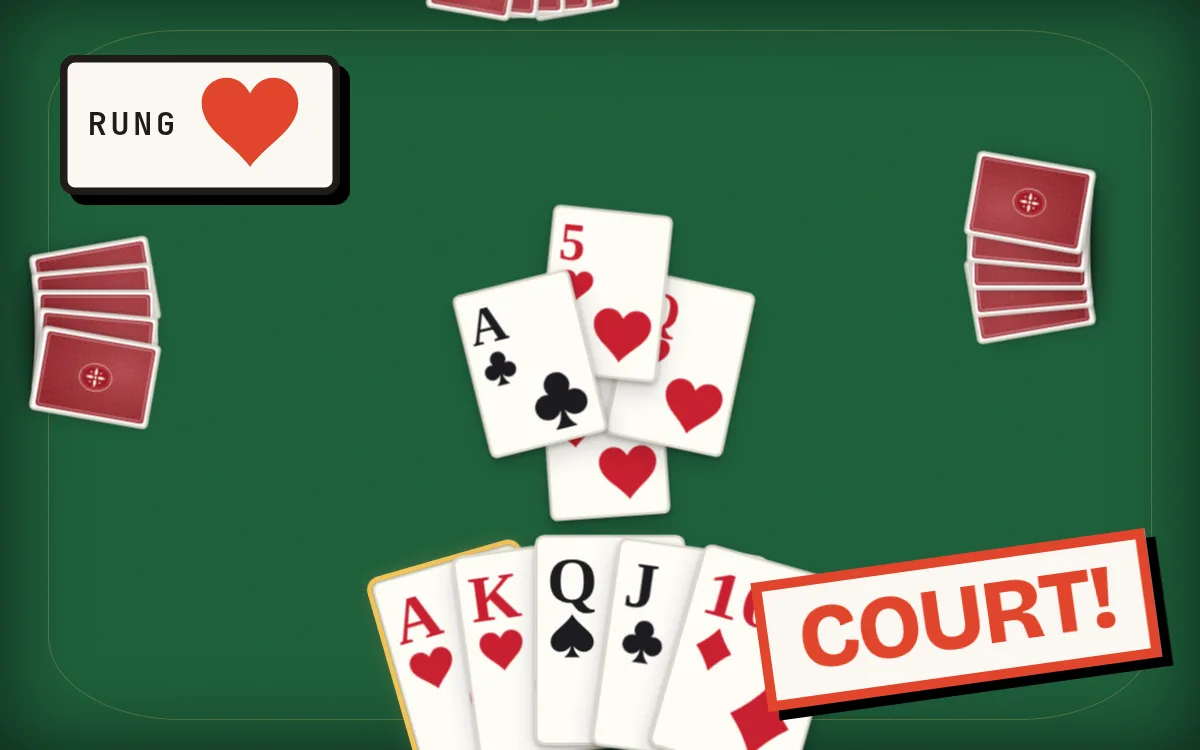
In Rung the trump caller names the rung after seeing only their first five cards, then leads the first trick. A good call gives your team control of the round: you hold the trumps, you decide when to draw them, and your side cards become safe. A bad call hands that control to the other team.
There is also a reward for calling well over and over. In our Rung game, as in most homes, a calling team that wins the round keeps the call for the next one. A strong caller can stay in charge for a long stretch of the match.
Rule one: length beats strength
Count how many cards you hold in each suit. The suit with the most cards is usually your trump. Three cards of one suit in the first five is a solid call. Four or five is excellent.
Why length? Because trumps win tricks by cutting. Every trump you hold is a card that can take a trick in a suit you are out of. A long trump suit also lets you draw the opponents' trumps and still have some left.
Here is the maths. If three of your first five cards are hearts and you call hearts, the other eight cards you receive come from 47 cards that still contain ten hearts. On average you pick up about two more, so you end up with around five trumps. Your partner, on average, holds about three. Together that is roughly eight of the thirteen trumps, a clear majority.
Rule two: honours break ties
When two suits are the same length, choose the one with the higher cards. An Ace or King in your trump suit is worth a lot: it wins a trick, and it lets you draw trumps without losing control.
A handy way to score a suit is the one our own computer players use: three points for each card in the suit, plus four for the Ace, three for the King, two for the Queen and one for the Jack. Call the suit with the highest total. It is simple enough to do in your head. It favours length, but still lets an Ace-King pair beat three low cards.
Tip
Side-suit Aces are winners whatever you call. Do not choose trump to protect an Ace; choose trump where you are long, and let the Ace win on its own.
Five worked hands
Here are typical first-five hands and the call we would make.
- A♠ K♠ 7♠ 4♥ 9♦. Call spades. Three cards with the Ace and King on top is close to ideal.
- Q♥ 9♥ 6♥ 3♥ A♣. Call hearts. Four trumps outweigh the missing honours, and the Ace of clubs wins anyway.
- K♦ 8♦ A♣ 5♣ J♠. Two diamonds and two clubs. Clubs score 3+3+4 = 10 against diamonds 3+3+3 = 9, so call clubs, with the Ace on top of your trumps.
- 9♠ 7♠ 4♠ A♥ K♦. Call spades. Three low trumps (9 points) beat a lone Ace (7), and the Ace of hearts still wins its trick.
- J♥ 10♥ 8♥ A♠ K♠. The rare case where honours win. Hearts score 10, but Ace-King of spades score 13: both are near-certain trump winners, while three low hearts can all be overtrumped. Call spades.
What to lead after you call
As the caller you lead the first trick, and your first lead says a lot to your partner.
If you are long in trumps with the Ace or King, lead trumps early. Pulling the opponents' trumps out makes your side Aces and Kings safe, because nobody can cut them later. If your trumps are long but low, lead a side-suit Ace first to win a quick trick, then start on trumps when you know more.
If your call was a stretch, with only two trumps, do not lead trumps at all. Lead your strongest side suit and keep your few trumps for cutting.
When the other team calls
If you are defending, the caller's team usually holds more trumps. Your job is to win your seven tricks with side-suit honours and the odd well-timed cut.
Cash your Aces early, before the caller's team draws trumps and runs their long suit. Watch which suits the caller's partner runs out of, and avoid leading those, because that partner can cut. And count trumps as they fall; once they are gone, your Kings and Queens become winners. Our Rung partnership strategy goes deeper into defence.
Common calling mistakes
A few habits cost rounds before the first card is played.
- Calling a short suit because it holds the Ace. The Ace wins anyway; the call needs length.
- Forgetting that your partner holds cards too. Even a two-card trump call is backed up, on average, by about three trumps in your partner's hand.
- Calling slowly and changing your mind. In our game the call is final once you tap a suit, so count first, then tap.
Questions people ask
- How many trumps do I need to call in Rung?
- Three of your first five cards in one suit is a solid call. Two can work if they are the Ace and King, but most of the time length matters more than honours.
- Should I choose trump based on my Aces?
- Not mainly. Side-suit Aces win tricks whatever is trump. Choose the suit you hold the most of, and use honours to break ties.
- Should the caller lead trump first?
- Yes if you hold several trumps including the Ace or King. Drawing the opponents' trumps protects your side-suit winners. With only two trumps, lead a strong side suit instead.
- How does the computer choose trump in your Rung game?
- It scores each suit: three points per card, plus four for the Ace, three for the King, two for the Queen and one for the Jack, and calls the highest. Easy computers sometimes call at random.