ComparisonRung
Rung vs Hokm vs Spades: three partnership trick games
Three games with the same bones: four players, two teams, thirteen tricks and a trump suit. Rung and Hokm are close cousins; Spades took the idea somewhere very different.
4 min readUpdated By PlayNest team
The family resemblance
All three are trick-taking games for four players in fixed partnerships, with partners sitting opposite each other. All three use a standard 52-card deck, ranks from Ace down to 2, and the rule that you must follow the led suit if you can. All three have a trump suit that beats every other suit.
The differences are in who decides trump, how a hand is won and how points are counted. Those three things make the games feel very different at the table.
Rung (Court Piece) in brief
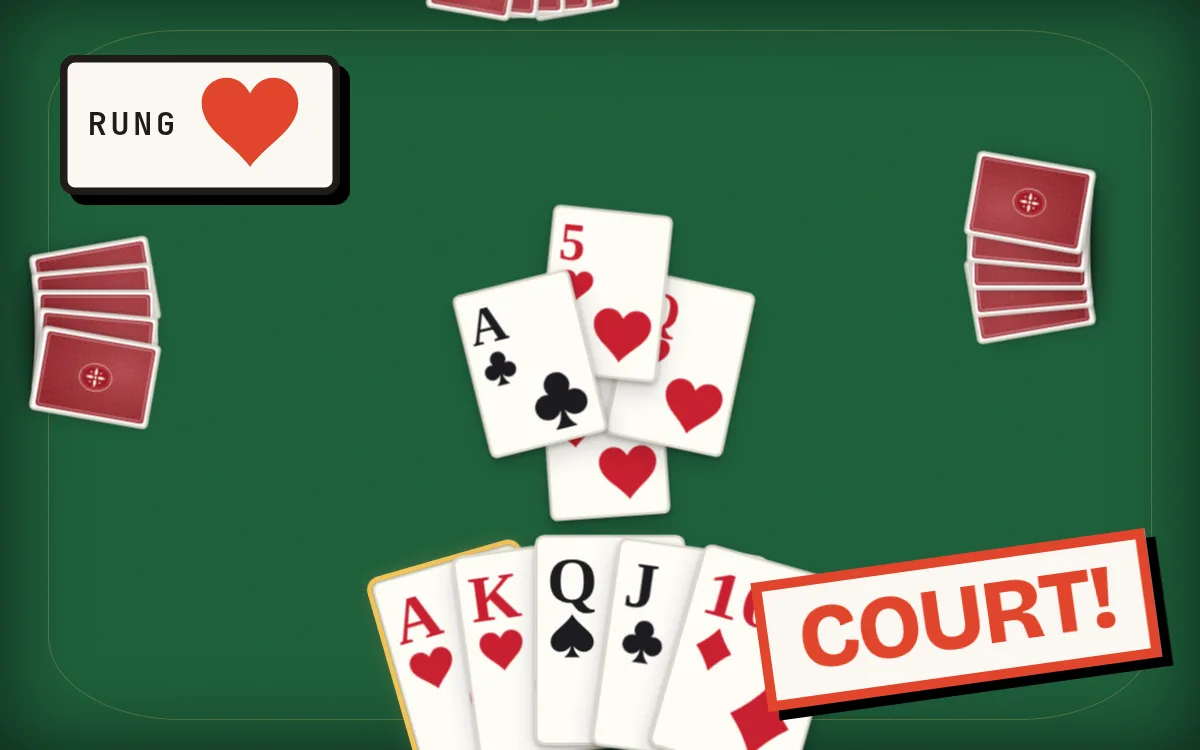
One player, the caller, names trump after seeing only five cards. The rest of the deal follows in two packets of four. Both teams race to seven tricks, and the first to reach seven wins the round for one point. Winning the first seven tricks in a row is a Court, worth two points with the usual bonus. A match runs to a target such as 5 or 7 points. Play runs counter-clockwise.
That is exactly what our Rung game plays; see Rung rules for every detail.
Hokm in brief
Hokm is the Persian game Court Piece grew out of, and the word hokm means command or ruling: the trump. It is still widely played in Iran and among Iranians abroad.
At the start of a game, cards are dealt face up one at a time until someone receives an Ace. That player becomes the hakem, the ruler. The hakem receives five cards, chooses trump from them, and then everyone is dealt the rest in fours, so the deal is the same five, four, four pattern as Court Piece. The hakem leads, and the first team to seven tricks wins the hand.
A clean sweep of seven tricks to nothing is called a kot and scores more than a normal win, with an even bigger reward when the defending team sweeps the hakem's side. The hakem keeps the role while their team wins, and the role passes on when they lose. Matches are usually played to seven points. Play runs counter-clockwise, as in Court Piece.
Spades in brief
Spades is an American game from the twentieth century, and it changed the formula in two big ways.
First, trump never changes: spades are always trump. Nobody calls anything. Spades cannot be led until one has been played on another suit, which is called breaking spades.
Second, there is bidding. After all thirteen cards are dealt, every player bids how many tricks they expect to win, and partners add their bids together as a contract. All thirteen tricks are played. A team that makes its contract scores ten points per trick bid, plus a point for each extra trick, known as a bag; too many bags cost a penalty. A team that falls short loses ten points per trick bid. A player can also bid nil, promising to take no tricks at all, for a large bonus or penalty. Games usually run to 500 points, and play goes clockwise.
Side by side
The main differences at a glance:
- Who picks trump: in Rung the caller chooses from five cards. In Hokm the hakem chooses from five cards. In Spades it is always spades.
- Deal: Rung and Hokm deal five first, then four and four. Spades deals all thirteen at once.
- Bidding: none in Rung or Hokm. Spades is built around it.
- How a round ends: Rung and Hokm stop as soon as a team has seven tricks. Spades plays all thirteen.
- Big bonus: a Court in Rung, a kot in Hokm, a successful nil bid in Spades.
- Scoring: Rung and Hokm count rounds won, to a small target. Spades counts tricks against bids, to 500.
- Direction: counter-clockwise in Rung and Hokm, clockwise in Spades.
Which one should you learn?
If you grew up in Pakistan or North India, Rung is the one your family will want to play, and its rounds are short enough that a match fits into an evening. Learning to choose trump from five cards is the key skill.
If you have Iranian friends, Hokm will feel instantly familiar after Rung. The main things to adjust are how the first hakem is chosen and how the kot is scored. Our article on Coat Piece and Hokm covers the names and history.
If you play with friends in North America, Spades is the common ground. Its bidding adds a layer of planning that Rung does not have, but you lose the drama of a caller staking the round on five cards.
Questions people ask
- Is Court Piece the same as Hokm?
- They are very close. Both have a player choosing trump from five cards, a 5-4-4 deal and a race to seven tricks. Hokm chooses its first hakem by dealing until someone gets an Ace, and its kot scoring differs a little.
- Is Rung like Spades?
- Both are partnership trick games, but Spades always uses spades as trump, has bidding, and plays all thirteen tricks. Rung has a chosen trump, no bidding, and ends when a team reaches seven tricks.
- Which game is easiest to learn?
- Rung and Hokm, because there is no bidding. If you can follow suit and know what trump is, you can play your first round in minutes.