Skip to content
اردو
PZL: Puzzle & Brain

Nonograms

PuzzleSoloMedium~10 min

Ready to play · free

Picross, Griddlers and Hanjie: fill the grid from the number clues and reveal a hidden picture. 120+ puzzles from 5x5 to 20x20 and a daily puzzle.

Rate this game

Be one of the first to rate it.

Game info

Developer
PlayNest Studio
Released
Last updated
Platforms
Browser, Android, iPhone, PC
Players
1 player
Average play time
~10 min per round
Languages
English, Urdu
Controls
Keyboard or mouse on computers, touch on phones and tablets
01

How to play

  1. Read the numbers beside a row or column. Each number is a run of filled squares, in order, with at least one gap between runs.
  2. Tap or click a square to fill it, or drag along a line to fill several. Use the Cross tool (or right click) to mark squares you know are empty.
  3. Start with the biggest numbers and with lines where the clue almost fills the whole line. The squares in the middle are certain.
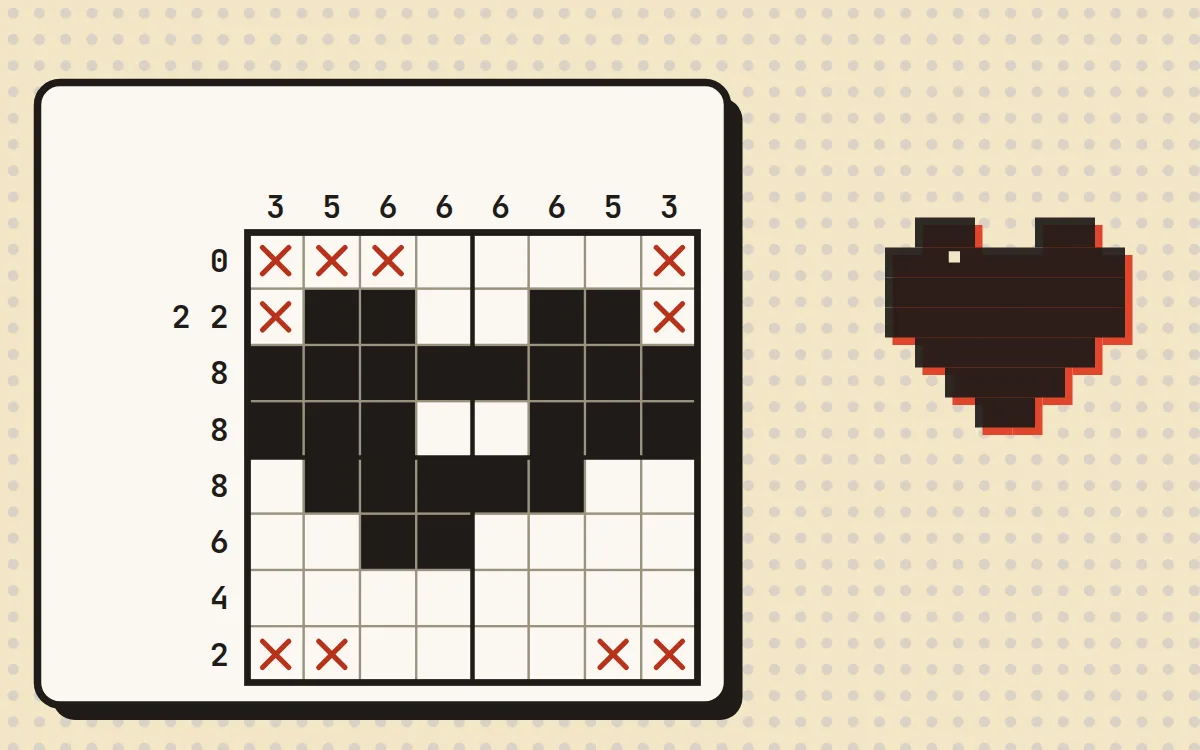
  4. Finished lines turn grey and get crossed out for you. Complete the grid to reveal the picture.
02

Controls

Keyboard & mouse

ClickDrag
Fill squares
Right clickX
Cross out a square
←↑→↓
Move the cursor
SpaceEnter
Fill the cursor square
ZY
Undo, redo
H
Hint
PEsc
Pause

Touch

Tap
Fill or cross a square
Drag
Fill or cross a whole line
Fill / Cross switch
Choose what a tap does
Pinch or +/-
Zoom the board
Move tool
Pan a zoomed board
03

About

Nonograms, also called Picross, Griddlers and Hanjie, are picture logic puzzles. The numbers beside each row and column say how many squares in a row to fill, and when every clue is satisfied a hidden picture appears. Play more than 120 puzzles from 5x5 to 20x20 plus wide grids, a daily puzzle, hints, undo and a mistake check, with every puzzle solvable by logic alone.Also known as Nonogram, Picross, Griddlers, Hanjie, Paint by Numbers, Nonogram puzzles, Japanese crossword, Nonogramme, Nonogramm, Nonograma, Japanse puzzel.

04

Tips & tricks

  • Work first on the line with the least slack: clue total plus gaps close to the line length.
  • Cross out squares you know are empty, not just the ones you fill. Crosses unlock the edge and splitting tricks.
  • A long block in a short line always overlaps with itself, so some squares in the middle are certain.
  • Stuck? Press Hint to see the next certain square and the row or column it comes from.

Nonograms: complete guide

Nonograms, also known as Picross, Griddlers, Hanjie and paint by numbers puzzles, are logic puzzles where the numbers beside every row and column tell you which squares to fill. Fill them all correctly and a hidden picture appears. Play nonograms online free here: more than 120 puzzles from 5x5 to 20x20, wide and tall grids, a daily puzzle, hints, undo, a mistake check, auto cross-out and a colour-blind friendly mode. Every puzzle has exactly one solution that logic alone can find, so you never have to guess.

How to play nonograms online

A nonogram is a grid of empty squares with a row of numbers at the left of each row and above each column. Those numbers are the clues. Each number is the length of one run of filled squares in that line, and the runs appear in the same order as the numbers, with at least one empty square between two runs. Your job is to fill the right squares so that every row and every column matches its clues. When the last square is right, the picture is complete and the game plays a short reveal.

You do not need to know how nonograms work to start. Pick a small 5x5 puzzle and tap a square: it fills. Tap a filled square and it empties again. Use the Cross tool (or right click on a computer) to put an X on squares you are sure are empty. The crosses do nothing to your score; they are your own notes, and they make the picture easier to see.

  • Choose a puzzle from the size tabs: 5x5, 10x10, 15x15, 20x20 or a wide or tall rectangle.
  • Read the clue for a line. A clue of 3 1 means a run of three filled squares, then at least one gap, then one filled square.
  • Fill what you are sure about and cross out what you know is empty.
  • Keep going line by line. Every new square gives new information to the lines that cross it.
  • Finish the grid to reveal the picture. There is no move limit and no lives, only the clock.

How to read nonogram clues

The clue for a row sits at its left end and the clue for a column sits above it. A single number, such as 5, means one block of five filled squares somewhere in that line. Several numbers, such as 2 1 3, mean three separate blocks of two, one and three squares in that order from left to right (or top to bottom), each pair separated by at least one empty square. A line with the clue 0 (shown as an empty line) has no filled squares at all.

A useful habit is to add up the clue numbers and the minimum gaps. The line 2 1 3 needs 2 + 1 + 3 = 6 filled squares plus 2 gaps, so at least 8 squares. In a 10-square line that leaves only 2 squares of slack, and that slack is exactly what makes the first deductions possible.

  • When a clue is complete, the numbers fade to grey and the leftover empty squares in that line get crossed out for you (you can switch this off in Settings).

How to solve nonograms: the core techniques

Almost every nonogram can be solved with a handful of ideas. They work on one line at a time, then the result feeds the crossing lines. This is the whole method, and it is why our puzzles never need a guess.

  • Full lines. If the clue plus its gaps exactly equals the length of the line (for example 3 2 in a 6-square line), the line is fully decided: fill, gap, fill. Start every puzzle by looking for these.
  • Overlap (the simple boxes technique). Slide the biggest block as far left as it goes, then as far right. The squares covered both times must be filled. A clue of 8 in a 10-square line fills squares 3 to 8 for certain, because the block can only shift by two.
  • Edges. If a square at the very end of a line is filled, the first block must start there, so you can fill the whole first block and cross the square after it. The same works from the other end.
  • Simple spaces. If a gap between crosses is smaller than the smallest block that is still unplaced, nothing can go there, so cross it out.
  • Glue and joining. If two filled squares are in the same block, everything between them is filled too. If a filled square must belong to a given block, you can often extend it to the block's full length from one side.
  • Splitting. A cross in the middle of a long space divides the line into two parts, and each block must fit entirely inside one part. Count which blocks can still fit where.
  • Counting remaining blocks. Once the long blocks are placed, the small ones are forced into the leftover spaces. Cross the squares that no remaining block can reach.

Nonogram tips for faster, cleaner solving

Work on the line that has the least slack, not the line you happened to look at last. Slack is the line length minus the clue total and gaps. Rows and columns with a slack of zero are free squares, slack of one or two gives a few overlaps, and anything with a large slack should wait until its crossing lines have been filled.

Cross out as you go. An empty square that stays blank is ambiguous: do you know it is empty, or have you not looked at it yet? Marking it with a cross turns your knowledge into something you can see, and it unlocks edge and splitting deductions. When you pause a puzzle and come back later, the crosses tell you exactly where you were.

Do not guess. Every puzzle here can be solved by looking at rows and columns separately, one after the other. If you feel stuck, loop through the lines again: a new square somewhere almost always gives a line one more deduction. If you really are stuck, the Hint button finds the next certain square and shows you which row or column it comes from, so you can learn the reasoning instead of just copying it.

Nonograms 5x5 to 20x20, plus wide and tall grids

The puzzle shelf has five tabs. The 5x5 puzzles are quick warm-ups of one to three minutes, good for learning. The 10x10 puzzles are the classic size: ten to twenty minutes, with enough clues to need every technique above. The 15x15 puzzles take a good half hour and have long clues. The 20x20 puzzles are large pictures for an evening with a cup of tea. The Wide tab collects rectangles, such as 12 columns by 6 rows, because a nonogram does not have to be square.

In total there are more than 120 shipped puzzles. Some are hand-drawn pixel pictures (a cat, a rocket, a butterfly, a lighthouse, a sailing boat) and the rest are generated ink-blot pictures. The Random puzzle button makes a new picture of the size you have selected, every time, so you can practise as long as you like. Solved puzzles show their finished picture on the puzzle card with your best time.

The daily nonogram puzzle

The Daily puzzle is chosen from the date, so everyone who plays today gets the same picture. It is a 10x10 or 15x15 puzzle, which makes it a good once-a-day habit. Your time for the day is saved, and finishing it marks the day as done on your daily challenge list.

Controls: phone and computer

On a phone, the toolbar at the bottom has a big switch between Fill and Cross, so your thumb never has to hunt for a tiny button. Tap a square to apply the current tool. Drag across several squares to fill or cross a whole line in one stroke: the drag locks to a single row or column once it starts, so a wobbly finger does not paint the wrong squares. Starting a drag on a filled square erases instead of filling, so the same gesture removes mistakes.

On a computer, left click fills, right click crosses, and you can drag the same way. The keyboard works too: the arrow keys move a cursor, Space or Enter fills, X crosses, Z undoes, Y redoes, H gives a hint and P pauses. Press Escape to open or close the pause screen.

  • Undo and redo step back through every stroke, including the squares that were crossed out for you automatically.
  • Zoom in with the plus button, pinch with two fingers, or hold Ctrl and use the mouse wheel. When you are zoomed in, a third tool called Move appears so you can pan the board with one finger without painting by accident.
  • Clear wipes the board after asking for confirmation. Pause hides the board and stops the clock.

Error check, hints and auto cross-out

Three helpers can be used or ignored. The Check button (a shield icon) switches mistake display on: any filled square that should be empty, and any crossed square that should be filled, gets a red outline, or a hatched pattern in colour-blind mode. A small counter shows how many mistakes are on the board. Leave it off if you want the full challenge and a cleaner time.

The Hint button finds a square you can deduce from the squares you already have right. It fills or crosses that square and flashes the row or column the deduction came from. Hints are counted and shown in your result, so you can try to finish a puzzle with none.

Auto cross-out, on by default, crosses the empty squares of a row or column the moment its clue is satisfied. It saves a lot of tapping on big grids and doubles as a quiet confirmation that a line is correct.

Colour themes and colour-blind friendly mode

Choose the ink your filled squares use: classic black ink, tomato, cobalt, teal or pink. When you finish a puzzle the picture is revealed in a small palette of print colours, from top to bottom of the grid. The Colour-blind friendly switch in Settings changes the palette to blue and orange tones that stay distinct for the common kinds of colour blindness, draws crosses thicker, and marks mistakes with diagonal stripes instead of relying on red alone.

Nonogram, Picross, Griddlers and Hanjie: what is the difference?

They are the same puzzle with different names. Non Ishida and Tetsuya Nishio, two Japanese puzzle designers, invented it independently in 1987. Nintendo made it famous as Picross (picture crossword) from the 1990s, newspapers in Britain called it Griddlers, Eastern Europe knows it as Hanjie, and the generic English word nonogram comes from Ishida's first name. In French you will see nonogramme or picross, in German Nonogramm or Bilderrätsel, in Dutch a Japanse puzzel, and in Spanish nonograma or crucigrama japonés. Some apps add colour clues to the rules; this game uses the classic black-and-white kind, where the picture is revealed in colour at the end.

How we guarantee a single solution

A badly made nonogram can have several valid answers, and then the only way through is a guess. That is not how a logic puzzle should feel. Every puzzle here is run through a line solver before it ships: a program that applies the line techniques above, over and over, to see whether the clues alone fill the whole grid. If it does, the solution is unique and the puzzle is solvable by logic. Generated puzzles are kept only when they pass that same test, and the test runs again whenever the code changes. Your progress is saved in your browser, so you can leave a puzzle half done and continue it later.

05

Nonograms FAQ

Is Nonograms free to play?
Yes. Nonograms is completely free on PlayNest. There is nothing to buy and no account to create.
Do I need to download Nonograms?
No. Nonograms runs in your web browser, so you can start playing straight away on Chrome, Safari, Edge or Firefox.
Can I play Nonograms on my phone?
Yes. Nonograms works on Android phones, iPhones, tablets and computers, with touch and keyboard controls.
How many players can play Nonograms?
It is a single-player game.
How long does a game of Nonograms take?
A round takes about 10 minutes. It is rated medium and sits in our Puzzle & Brain collection.
What is a nonogram?
A nonogram is a logic puzzle on a grid where number clues beside each row and column say how many consecutive squares to fill. When all clues are satisfied, the filled squares make a picture. It is also called Picross, Griddlers, Hanjie or a paint by numbers puzzle.
Is a nonogram the same as Picross?
Yes. Picross is the name Nintendo used for its nonogram games. The rules are identical: use the row and column numbers to decide which squares are filled.
Can I play nonograms online for free?
Yes. Nonograms on PlayNest is free in your browser on phone, tablet or computer. There is no sign-up, no download and no limit on how many puzzles you play.
How do I solve nonograms for beginners?
Start with lines where the clue plus gaps nearly fills the whole line, because the middle squares are certain. Cross out squares you know are empty, then move to the crossing lines and repeat. Small 5x5 puzzles are ideal practice.
Do I ever have to guess in a nonogram?
Not here. Every puzzle has exactly one solution that can be found by looking at one row or column at a time. If you feel you need to guess, loop through the lines again or press Hint.
What do the numbers mean in a nonogram?
Each number is the length of a run of filled squares in that row or column. Several numbers are several runs in that order, with at least one empty square between them.
How big can the puzzles get?
Puzzles go from 5x5 up to 20x20, and there are wide and tall rectangles too. On a phone you can zoom in and pan with the Move tool to work on large grids comfortably.
How many puzzles are there?
More than 120 are built in, from hand-drawn pictures to generated ones, and the Random puzzle button makes a new one of any size whenever you like.
Is there a daily nonogram?
Yes. The Daily puzzle is the same for everyone each day, so you can compare notes and times with friends.
Can I check my mistakes?
Yes. Turn on Check to mark wrong squares as you go, or leave it off for the full challenge. You can also use Undo to step back through your strokes.
Can I get a hint?
Yes. The Hint button finds a square that logic proves is right and shows which row or column it comes from. Hints are counted in your result.
Is my progress saved?
Yes. Your board, clock and solved puzzles are stored in your browser, so you can close the page and come back to the puzzle later.
Does it work on a phone?
Yes. The game is built phone first with a large Fill and Cross switch, drag-to-fill, pinch and button zoom, and a Move tool for panning.
Is there a colour-blind mode?
Yes. The Colour-blind friendly switch in Settings uses a blue and orange palette, bolder crosses and striped mistake marks so nothing depends on telling red from green.
06

You might also like

More Puzzle & Brain