Rules
How to play Belote: rules, bidding and scoring
Belote is the great French partnership card game, and Coinche (Contrée) is its bidding version. This guide explains the deal, the rules of play, what every card is worth and exactly how a deal is scored, with worked examples you can check on the table.
10 min readUpdated By PlayNest team
What kind of game Belote is
Belote is a trick-taking game for four players in two fixed partnerships. You and the player opposite you are a team. One team chooses a trump suit and becomes the takers; the other team defends. The takers have to collect more points than the defenders, and the points come from the cards inside the tricks you win, not from the number of tricks.
There are two main ways to play. Classic Belote (belote classique) chooses trump with a face-up card, which makes it quick to learn. Coinche, also called Contrée or belote coinchée, chooses trump with an auction in which players bid how many points they will make. Card values and the rules of play are the same in both.
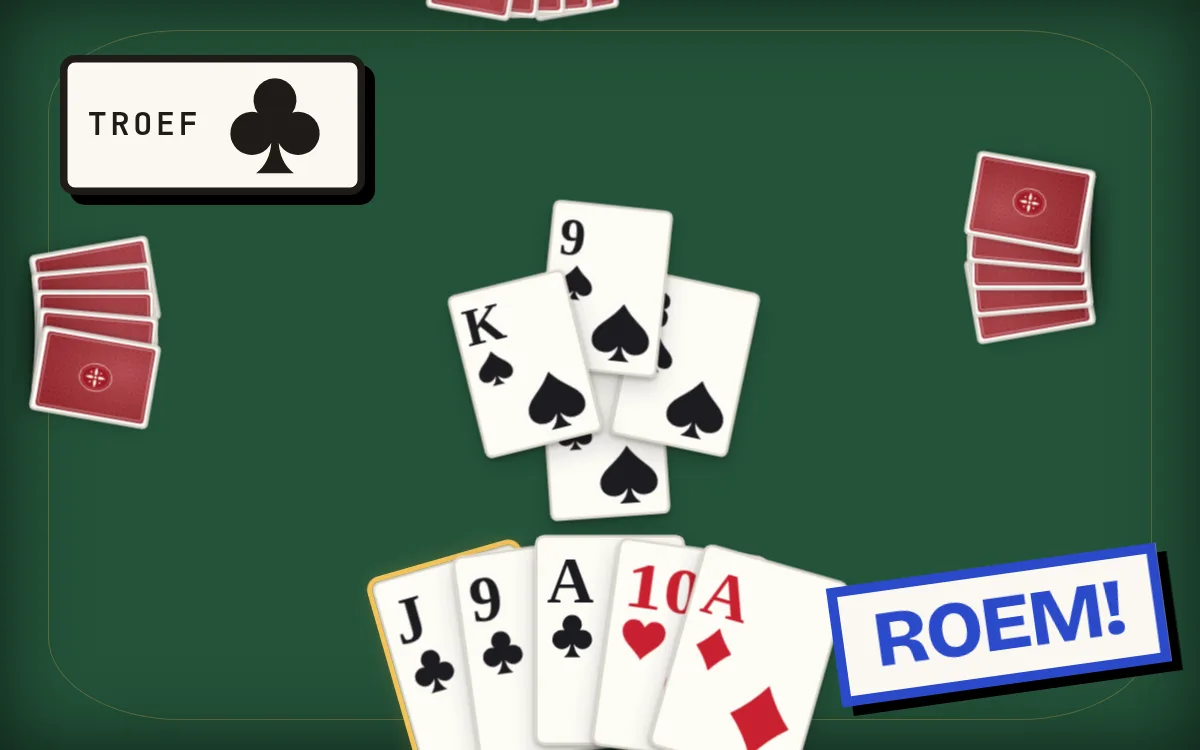
Everything below matches the rules used in our free Belote game, so you can read a section and then try it straight away against the computer. Highlighted cards show what you are allowed to play, which makes learning much easier.
The deck, the seats and the direction of play
Belote uses a 32-card deck: 7, 8, 9, 10, Jack, Queen, King and Ace in each suit. If you only have a normal 52-card pack, take out the 2s to 6s.
Partners sit opposite each other. Play moves counter-clockwise, to the right, which is the French tradition. The player after the dealer bids first, and in Classic Belote that same player leads the first trick. The deal passes to the next player after every hand.
The deal and taking trump in Classic Belote
Classic Belote deals the cards in two stages, with the trump decision in between.
- The dealer gives five cards to each player, three and then two.
- The next card from the pack is turned face up on the table. It is called la retourne.
- First round: starting after the dealer, each player either takes the suit of the turned card as trump (prendre) or passes.
- Second round, if all four passed: each player may name any of the other three suits as trump, or pass. This is sometimes called taking à deux.
- If everybody passes again, the hand is thrown in and the next dealer deals a fresh hand.
- The player who took receives the turned card plus two more cards, and the other three players receive three cards each. Everyone now holds eight.
Tip
Taking with the turned card is a commitment for your whole team. A Jack or a 9 of that suit in your first five cards is the usual reason to take.
Rules of play: following suit, trumping and overtrumping
The player after the dealer leads any card to the first trick. Each player in turn adds one card, and the winner of the trick leads the next one. The rules for which card you may play are stricter than in most trick-taking games:
- Follow suit if you can.
- Partner winning: if you cannot follow suit and your partner is currently winning the trick, you may play any card.
- Must trump: if you cannot follow suit and your partner is not winning, you must play a trump.
- Overtrump: if an opponent has already trumped, you must play a higher trump if you can. If you cannot beat it, you must still play a trump.
- Trump led: when trump is led, you must play a higher trump than the best one on the trick if you have one.
- The highest trump wins the trick. With no trump on it, the highest card of the led suit wins.
Belote card values and order
The trump suit has its own order. The Jack of trump is the strongest card in the game and the 9 of trump is second, which surprises everyone who comes from Rummy or Bridge.
- Trump, highest to lowest: Jack 20, 9 14, Ace 11, 10 10, King 4, Queen 3, 8 0, 7 0 (62 points).
- Other suits, highest to lowest: Ace 11, 10 10, King 4, Queen 3, Jack 2, 9 0, 8 0, 7 0 (30 points each).
- The whole deck holds 152 card points.
- Dix de der: the team that wins the last trick earns 10 more points, so every deal is worth 162.
Tip
Notice how valuable the 10 is: it is worth almost as much as the Ace but loses to it. Protecting your 10s is one of the first skills to learn.
Belote rebelote, declarations and capot
Belote rebelote: a player who holds the King and Queen of trump scores 20 points for the pair. You say "Belote" when you play the first of them and "Rebelote" with the second. These 20 points always belong to the team holding the pair, whatever happens to the contract.
Declarations (annonces): Classic Belote also scores combinations in a single hand. Our game turns them on by default in Classic and makes them for you during the first trick. Sequences use the order A, K, Q, J, 10, 9, 8, 7 in one suit. Only the team with the best declaration scores, and it then scores all of its declarations.
- Tierce, three in sequence: 20.
- Cinquante, four in sequence: 50.
- Cent, five or more in sequence: 100.
- Four Jacks: 200. Four 9s: 150. Four Aces, 10s, Kings or Queens: 100.
- Capot, all eight tricks to one team: 250 instead of 162.
How Classic Belote is scored
When the eighth trick is played, each team adds its card points, the dix de der if it won the last trick, its belote rebelote and its declarations. Then the takers' total is compared with the defenders' total.
- Made: the takers score more than the defenders. Both teams score what they won.
- Failed (dedans or chute): the takers do not score more. The defenders score 162 plus all declarations. The belote rebelote stays with whichever team holds it.
- Tie (litige): the defenders score their points now, and the takers' points are held back for the winner of the next deal.
- Match: play to 501 or 1000. Once a team reaches the target, the highest total wins.
Worked example: scoring a Classic deal
Your team takes hearts. You hold the King and Queen of hearts, and your partner has a tierce in clubs. The opponents have no declaration, so your tierce is the best one on the table.
At the end of the deal your team has won 84 card points and also took the last trick, so you have 84 + 10 = 94. Add belote rebelote (20) and the tierce (20) and your total is 134. The defenders have the rest of the card points: 162 - 94 = 68. Since 134 is more than 68, the contract is made. Your team scores 134 and the opponents score 68.
Now imagine the same hand going badly. Your team ends with only 52 card points, the opponents 110, and there are no declarations this time. With belote you have 52 + 20 = 72, which is less than 110, so you are dedans. The defenders score all 162, and your team still keeps its 20 for belote rebelote. The deal ends 162 to 20.
One more lesson hides in these numbers: belote rebelote and declarations count towards beating the defenders. A team with 66 card points, belote and a tierce has 106, and that beats defenders holding 96 card points.
Coinche (Contrée): the deal and the auction
In Coinche every player gets all eight cards at once, in packets of three, three and two, and no card is turned up. Then comes the auction, starting with the player after the dealer.
- On your turn you pass, or you bid a contract and a trump suit: 80, 90, 100 and so on up to 160, or Capot (250), which promises all eight tricks.
- Each bid must be higher than the one before it. You can raise your partner's bid or overcall the opponents.
- An opponent of the highest bidder may say coinche, which doubles the stakes. The bidder's side may answer with surcoinche, which redoubles.
- The auction ends after three passes following a bid, or once a coinche has been answered.
- If all four players pass without bidding, the cards are redealt.
Tip
Belote rebelote still counts 20 for its holders in Coinche. Declarations are an option that is off by default, as many Coinche players prefer.
How Coinche is scored
The takers make their contract if their points, card points plus their own belote rebelote, reach the bid and are at least 82. A Capot contract needs every trick. Card points are rounded to the nearest 10 for scoring.
- Made: the takers score the bid plus their points. The defenders score their own points.
- Failed: the defenders score 160 plus the bid.
- Coinched: the side that wins the contract scores 160 plus twice the bid.
- Surcoinched: the side that wins scores 160 plus four times the bid.
- Match: play to 1000 or 2000 points.
Worked example: scoring a Coinche contract
First, a quick auction. Your partner opens with 80 hearts and the opponent on your left bids 90 spades. You cannot bid 90 hearts, because every bid must be higher than the last, so to play in hearts you would need at least 100. You decide your hand is not good enough and pass.
Now a deal to score. Suppose you bid 90 spades and everybody passes. You win 112 card points including the dix de der, and you hold no belote. Rounded to the nearest 10 that is 110, which reaches 90 and is above 82, so the contract is made. Your team scores 90 + 110 = 200. The defenders took 50 card points and score 50.
If an opponent had said coinche on your 90 spades and you made it anyway, your side would score 160 + 2 × 90 = 340. If you had won only 78 card points, rounded to 80, you would fall short of 90 and the defenders would score 160 + 90 = 250.
Belote vs Coinche: the real difference
Both games share the deck, the card values and the strict rules of play. The difference is the decision at the start. In Classic Belote you only answer one question, "do I want this turned suit, or another one?", and declarations add a bit of luck. In Coinche you have to put a number on your hand, judge what your partner's bid means, and accept that the opponents can coinche you if you overreach.
That makes Classic Belote the better first game and Coinche the deeper long-term game. Most French clubs and tournaments play Coinche, while family tables often stick with Classic. Our game lets you switch modes from the setup screen, so you can learn one and graduate to the other.
Beginner mistakes to avoid
These are the errors that cost new players the most points:
- Taking trump with a lone Jack and nothing else. You need support: another trump or two and an Ace on the side.
- Throwing a 10 onto a trick the opponents are winning. A 10 is worth 10 points, so throw a 7 or 8 instead.
- Forgetting that the 9 of trump is the second highest card. Count where it is before you lead your Ace of trump.
- Not giving points to your partner. When your partner is winning a trick, add a 10 or an Ace to it.
- In Coinche, bidding on hope. A failed contract gives the defenders 160 plus your bid.
Play Belote now
The fastest way to learn Belote is to play a few hands with the rules in front of you. Open our table to play Belote online free in your browser, with no download and no sign-up. Pick Classic or Coinche, choose Easy, Normal or Hard computers, and check the scoring screen after each deal against the examples above.
When you are ready, tap Invite friends to share a room link on WhatsApp and play with your own partner. Computers fill any empty seat, so you never need exactly four people to start.
Questions people ask
- How many cards does each player get in Belote?
- Each player ends up with eight cards from a 32-card deck. In Classic Belote they arrive as five, then three more after trump is chosen. In Coinche all eight are dealt at once.
- How many points are in a deal of Belote?
- There are 152 card points in the deck plus 10 for the last trick, so 162 in every deal. Belote rebelote, declarations and capot can add more.
- Do belote and declarations count towards making the contract?
- Yes. In Classic Belote the takers compare card points plus belote plus declarations with the defenders' total. In Coinche the takers' card points plus their own belote must reach the bid.
- What is the minimum bid in Coinche?
- The lowest bid is 80. Bids go up in steps of 10 to 160, and the highest bid is Capot, worth 250, which promises all eight tricks.
- What happens if everyone passes?
- In Classic Belote, if all four pass in both rounds the hand is thrown in and the next dealer deals. In Coinche, if nobody bids, the cards are redealt.