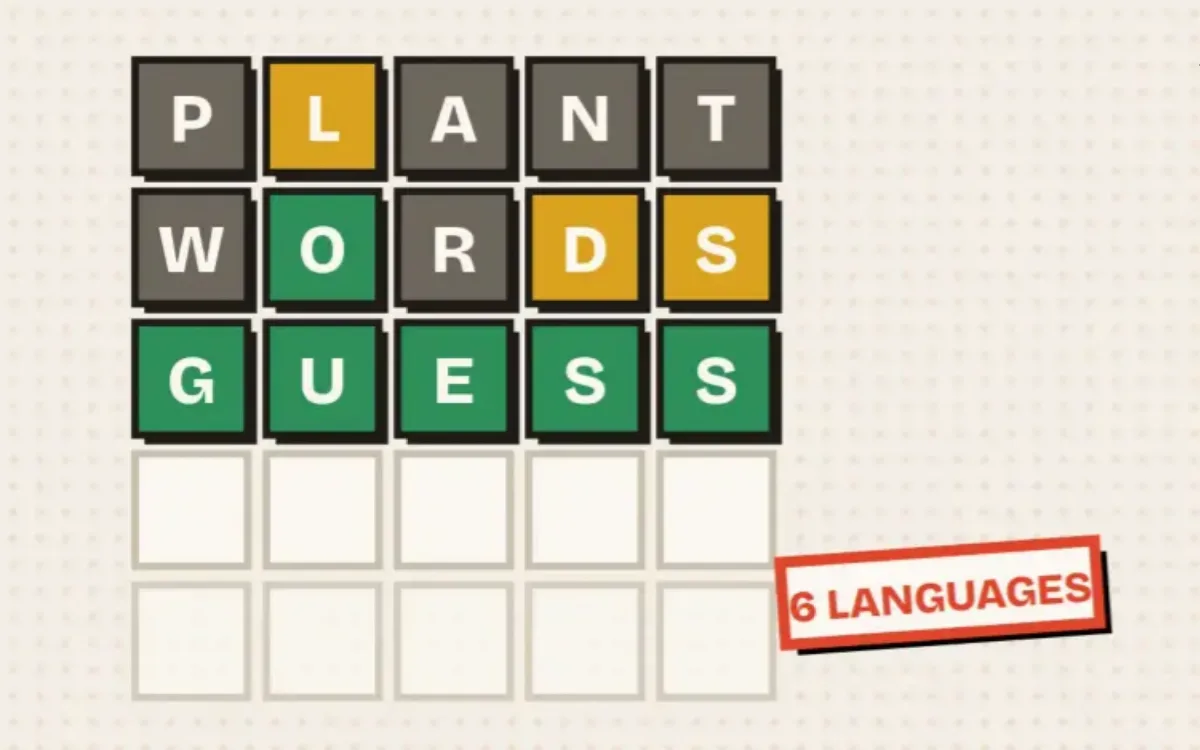
Word Guess is a free word-guessing game in the Wordle style: you have six tries to find a hidden word, and after each guess the tiles turn green, yellow or grey to show how close you were. There is a new daily word every day, the same for everyone, and an unlimited mode if you want another word right now, so it works as a Wordle alternative with no limit on how much you can play. Choose 4, 5 or 6 letters, switch on hard mode or colour-blind colours, and play in English, German, French, Spanish, Italian or Dutch. It runs in your browser with no download and no sign-up, and it is an independent game, not affiliated with the original Wordle or the New York Times.
A hidden word is waiting. Type a real word of the right length and press Enter. Every letter of your guess is then coloured to tell you something about the hidden word, and you use that information to make a better guess. You have six guesses in total.
- Green: the letter is in the hidden word and in exactly the right place.
- Yellow: the letter is in the word, but in a different place.
- Grey: the letter is not in the word, or all of its copies have already been accounted for.
- Only real words are accepted. If a word is not in the list the row shakes and nothing is used up, so a typo never costs you a guess.
- The on-screen keyboard also changes colour, so you can see at a glance which letters you have already ruled out.
If you like the idea of a daily five-letter word puzzle but want more than one a day, this is for you. The daily word is one game a day, and the unlimited mode (also called practice) hands you a fresh random word every time you finish, as often as you like. There is no waiting for midnight, no lives and no paywall. If you searched for unlimited Wordle, Wordle practice or a Wordle unlimited game, unlimited mode is exactly that.
The rules will feel familiar if you have played a Wordle-style game before, but there are a few things that make this one different: six languages, three word lengths, a colour-blind palette, and a result you can share without giving away the answer.
The daily word changes at midnight UTC. It is chosen from the date alone, so everyone playing the same language and length gets the same word on the same day, and you can compare how you did with friends and family. Each language and each length has its own daily word, so you can play several in one day if you want to.
Your daily game is saved as you go. If you close the tab halfway through, you will find your guesses waiting when you come back, and once you have finished, the result screen shows a countdown to the next word. Unlimited mode never touches your daily streak, so you can practise as much as you like without risking it.
Five letters is the classic length and the default: a 5 letter word game that is long enough to be a puzzle and short enough to finish in a few minutes. If you want something quicker, the 4 letter mode is a gentler game that suits younger players and anyone learning a language. If five has become easy, the 6 letter mode has more room for tricky letter combinations and takes more thought, even with the same six guesses.
Every combination of language and length has its own list of answer words and its own daily word, so you can move up and down in difficulty without running out of puzzles.
In hard mode, every hint you uncover has to be used in your next guess. A green letter must stay in its place, and any yellow letter must appear somewhere in the new word. The game tells you what is wrong, for example that letter 3 must be A, so you are never left guessing why a word was refused.
Hard mode makes the game less forgiving, because you cannot use a throwaway word to test new letters. You can switch it on at the start of a game or from the settings, but it cannot be turned on in the middle of a word. Winning in hard mode also earns an achievement and adds a star to the result you share.
Green and yellow are hard to tell apart for many people with colour vision deficiency. The colour-blind setting swaps them for orange (right place) and blue (wrong place), and the shared result uses matching orange and blue squares. The letters stay printed on every tile, and the keyboard follows the same palette, so nothing relies on colour alone.
Pick the word language before you start: English, Deutsch, Français, Español, Italiano or Nederlands. Each language has its own list of common answer words, with a much larger list of valid guesses behind it, so unusual but real words are accepted even if they will never be the answer. Answers are everyday words rather than obscure ones, and offensive words are left out.
A short note in each language for anyone searching in it. Auf Deutsch: Das ist ein kostenloses Wortspiel, bei dem du das Wort des Tages in sechs Versuchen rätst, ähnlich wie bei Wordle auf Deutsch, aber mit unbegrenzten Zusatzrunden. En français : un jeu de mots gratuit avec un mot du jour, comme un Wordle en français, avec autant de parties que vous voulez. En español: un juego de palabras gratis con una palabra del día y partidas ilimitadas, como un Wordle en español. In italiano: un gioco di parole gratuito con la parola del giorno e partite illimitate, per chi cerca un Wordle italiano. In het Nederlands: een gratis woordspel met een woord van de dag en onbeperkt oefenen, voor wie een Wordle in het Nederlands zoekt.
You never have to type accents. On the keyboard, just use the plain letter: type e for é or è, a for ä or à, u for ü, o for ö, c for ç. The game matches your guess against its word list ignoring accents, and then shows the word with its proper spelling, so a guess of MUDE appears as MÜDE. The colours are worked out on the plain letters too, so an accent can never change the result.
In Spanish the letter Ñ is kept as a letter in its own right, because ñ and n make different words, so Spanish has an extra key for it. If your physical keyboard types accented letters directly, those work as well and are treated the same way.
Words with ß are not used in the five-letter German list, so you will not need to worry about ss against ß.
The first guess has no information to go on, so the aim is to learn as much as possible. Choose a word with five different letters that are common in the language, with a couple of vowels. In English, words built from letters such as S, T, A, R, E, O, I and N do well. In German, E, N, I, R and S are the most common letters. In French, Spanish and Italian, A and E carry most of the work, together with R, S, T and N in French and Spanish, and with I, O, N and R in Italian. In Dutch, E, N and A lead.
Use your second guess to test new letters rather than to repeat the same ones in new places, unless you are in hard mode, where you have no choice. Watch for double letters: a word such as ABBEY has two Bs, and the game only marks as many copies of a letter as the word really contains, so a second B in your guess can turn grey even though B was yellow before.
When you have a few green letters, ask yourself which patterns could fit rather than guessing wildly. If you have _IGHT, many words fit (LIGHT, MIGHT, NIGHT, RIGHT, SIGHT, TIGHT, FIGHT), and it can be smarter to use a guess that tests several of the first letters at once than to try them one by one.
When you finish, the result screen builds a grid of coloured squares that shows how your game went without revealing the word. Press Copy to put it on your clipboard, or WhatsApp to send it straight to a chat. The first line gives the game, the language and length, the daily number and your score out of six (or X if you did not get it), with a star if you used hard mode.
Because the grid contains only colours, it is safe to post anywhere and your friends can still play the same daily word fresh.
Your stats are kept on your device for each language: games played, win percentage, current streak, best streak and a bar chart of how many guesses your wins took. A daily streak grows by one every day you solve that day's word and resets if you miss a day or do not solve it. Practice games count toward your totals and your guess chart, but not the streak.
Everything is stored in your browser. Clearing your site data clears your stats, so if you care about a long streak, avoid wiping data for this site.
Compared with the original Wordle, the rules are the same at heart, but this version has more languages, shorter and longer words, and no limit on play. Compared with a crossword, it is faster and has no clues: the only hints are the colours. Compared with Hangman, you guess whole words rather than letters one at a time, and every guess gives you positional information, which makes it closer to the board game Mastermind with words instead of coloured pegs.
If you like clues and grids, try our Mini Crossword. If you like numbers rather than letters, Sudoku is the closest in feel: a short, quiet logic puzzle with a clear solution.
The 4 letter mode and the unlimited mode make Word Guess a friendly tool for children learning to spell, and the six languages make it a light way to practise vocabulary in a language you are studying. Because only real words are accepted, a rejected guess is itself a small lesson. Play together on one device and take turns choosing the guess, or let a child type while an adult talks through which letters are still possible.