Rules
Petits chevaux rules and strategy: the complete guide
The common French rules of the jeu des petits chevaux in full, the variants families argue about, how the escalier and the exact final roll work, and the tactics that help you win a game that looks like pure luck.
7 min readUpdated By PlayNest team
What the jeu des petits chevaux is
The jeu des petits chevaux, the game of the little horses, is a dice race played by two to four people, popular in France and Belgium. It belongs to the family of Pachisi games, which also includes Ludo, the German Mensch ärgere dich nicht and the Spanish Parchís. Each player has four horses, traditionally small horse-shaped pawns, a die is thrown in turn, and the aim is to bring all four horses once around the board and up into the middle before anybody else.
It is a gentle game by the standards of the family: by default there are no safe squares, no bonus moves and no forced captures, and its biggest drama is the last step, where you need an exact number. You can play it in our free petits chevaux game against the computer, on one screen or online with friends.
The board: 56 squares, the escalier and the case centrale
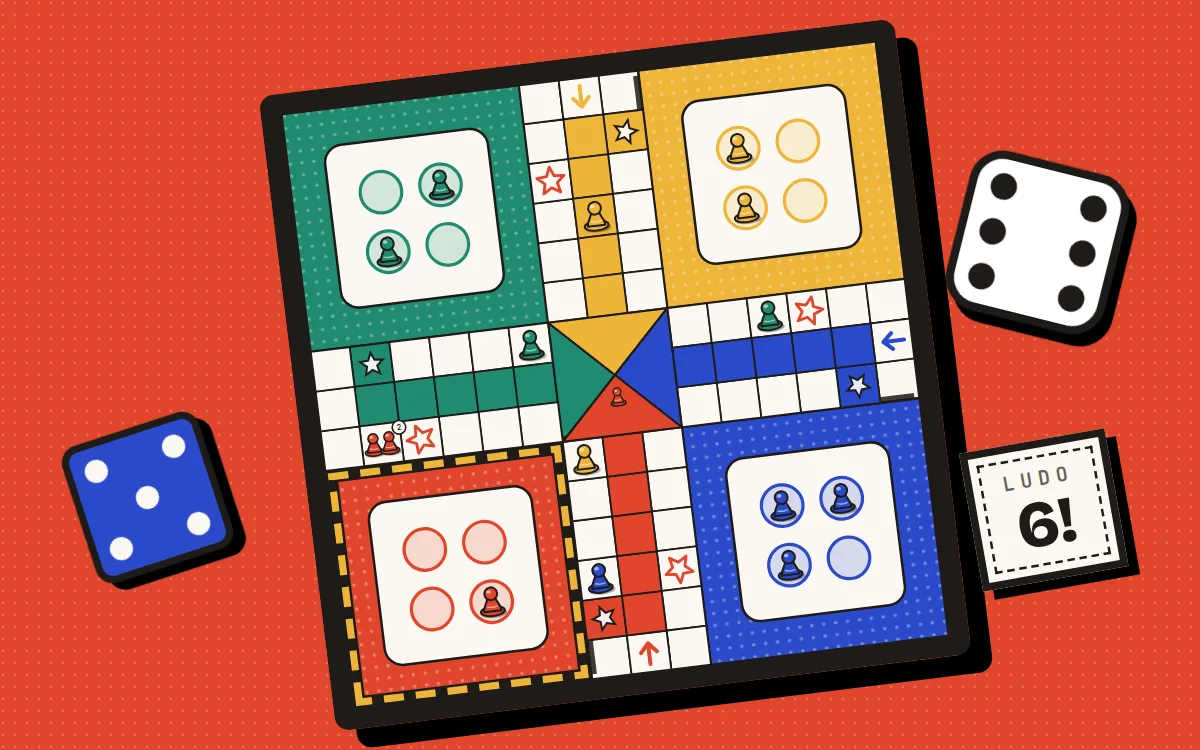
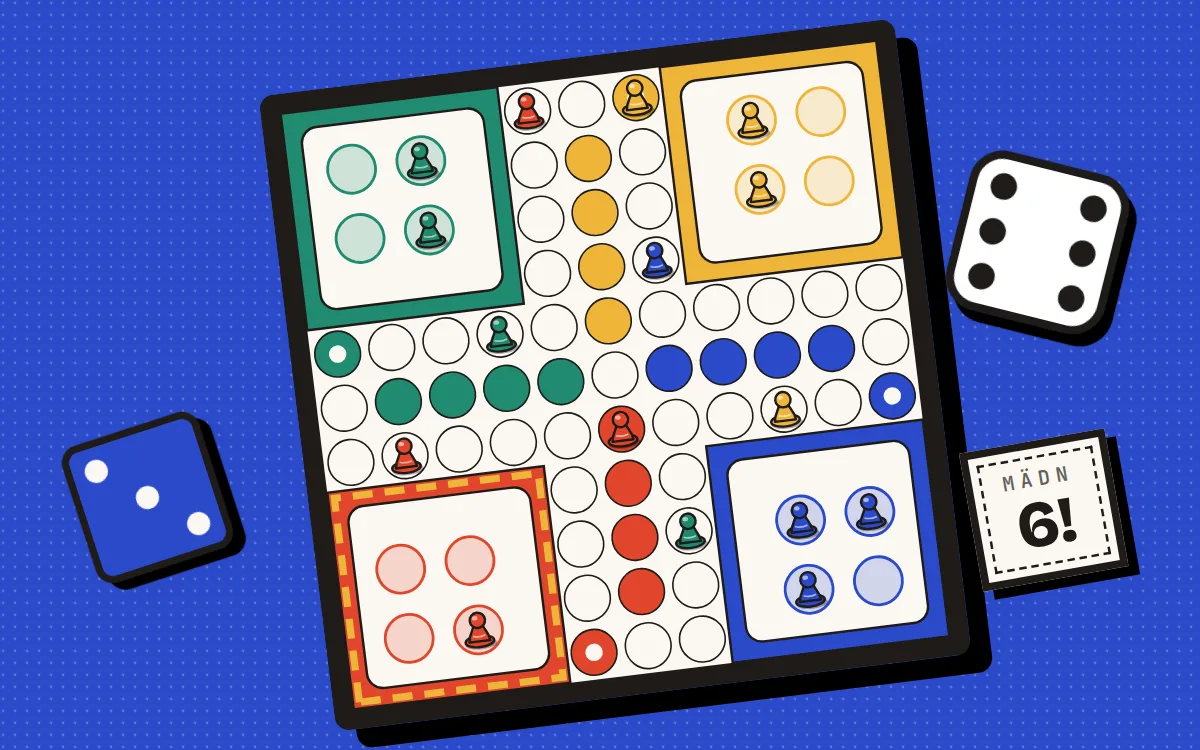
The board is a cross. A ring of 56 squares is shared by all colours. Each player has an écurie, the stable in a corner where the horses wait, a starting square on the ring and an escalier, a staircase of six coloured squares leading from the ring toward the middle. In the very centre is the case centrale, the square every horse is trying to reach, and it has room for all of them.
Horses travel clockwise. A horse that has left the stable stands on its starting square and goes all the way round the ring. On returning to the last ring square before its starting square it turns off into its own escalier instead of passing the start a second time. The escalier is private, so nothing is captured on it. From the last ring square a horse needs exactly seven steps to reach the case centrale: six squares of the escalier and then the centre.
Leaving the stable: the 6 and three tries
A horse leaves the stable only with a 6. It is placed on your starting square and, because every 6 gives another roll, you throw again. With no horse left in the stable a 6 simply moves a horse on the board six squares, and you still throw again, so the 6 is never wasted.
While all four of your horses are in the stable you get up to three throws in a row to find a 6, and the turn passes after the third miss. As soon as a horse is on the board you throw once, plus the extra throw after any 6. Some families let a 1 bring a horse out as well, and some throw only once per turn all the time, so both are options in the house rules.
Tip
Many people forget that a 6 which cannot bring a horse out (because none is in the stable) is still a normal move of six squares and still gives another throw.
Captures and the common variants
To capture, move a horse so that it ends exactly on a square holding an opponent's horse. The opponent's horse goes back to its stable and needs a 6 to start again. You may pass over other horses without touching them, and you cannot land on or capture anything on the escalier or on the centre.
This is the part where families disagree, so our game supports the usual variants as options. By default a horse leaving the stable captures an opponent standing on your starting square. You can switch that off, make the starting squares safe so that a horse standing on its own start cannot be taken, make capturing compulsory so that you must hit whenever you can, give a capturing player another throw, or let two horses on one square form a barrage that opponents can neither pass nor land on.
The exact roll to the centre
To land on the case centrale you need the exact number. A horse on the last ring square needs seven steps in total, a horse on the top step of the escalier needs one. A throw that would take the horse beyond the centre cannot be used by that horse, and if no horse can use the throw the turn passes. Horses on the escalier may move forward with smaller numbers, so a throw of 2 can move a horse from the second step to the fourth.
This makes the end of the game slow and tense. With three horses already home you can wait several turns for the number you need, and a player who looks hopelessly behind can win by finishing in the right order. The practical lesson is to bring your horses to the escalier early and keep them there as flexible targets for any number.
Strategy: how to win at petits chevaux
First, get more than one horse out. With two or three horses in play every throw has a useful use, and you are not forced into dangerous moves. Do not rush the first horse far ahead of the others: a lone horse is a target for every opponent behind it.
Second, count distances. A horse is in danger from every opponent horse one to six squares behind it, about one chance in six per horse each turn. If you must leave a horse in range, leave the one with the least ground covered. Third, use your starting square wisely. If entry capture is on, a horse waiting for a 6 on an opponent's start square can be hit when that opponent throws a 6, and your own start is hit the same way, so avoid standing on a start square in the last steps of your approach unless it is safe.
Fourth, plan the finish. Keep a spare horse on the ring to take throws that do not fit the escalier, and bring your front horse to the top steps so that small numbers can finish it. Against the Hard computer, expect it to capture whenever it pays and to avoid squares just in front of your horses. A patient game that waits for good numbers usually beats a fast race.
House rules, players and online play
In the house rules you can choose 6 only or 1 or 6 to leave the stable, switch the three tries, the throw after a 6, compulsory capture, safe starting squares, capture on leaving the stable and the barrage on or off, end at the first winner or play on for places, pick who starts and add a turn timer. Two, three or four can play, and the computer fills empty seats.
To play with friends, press Invite friends, send the link on WhatsApp or copy it, and wait for everyone in the lobby. Up to three friends can join without installing anything, and chat and voice chat are available. Quick match finds a table with other players. For the differences from the other family games, read Ludo vs Mensch ärgere dich nicht vs Parchís vs Petits chevaux, the Ludo rules and the Mensch ärgere dich nicht guide.
Les règles des petits chevaux en bref
Chaque joueur a quatre chevaux dans son écurie. Il faut faire un 6 pour sortir un cheval sur sa case de départ, et un 6 permet de rejouer. Si tous vos chevaux sont à l'écurie, vous avez trois essais. Un cheval qui s'arrête exactement sur un cheval adverse le renvoie à son écurie. Après un tour complet de 56 cases, il monte l'escalier et doit arriver sur la case centrale avec le chiffre exact. Le premier joueur dont les quatre chevaux sont au centre gagne. Vous pouvez jouer en ligne gratuitement, sans téléchargement, contre l'ordinateur ou avec des amis.
Questions people ask
- How many squares are there in petits chevaux?
- The ring has 56 squares shared by all colours, plus a private escalier of six squares for each player and the case centrale in the middle. A horse that has finished its lap turns into its own escalier, and from the last ring square it needs exactly seven steps to reach the centre.
- Do you need an exact number to finish?
- Yes. A horse needs the exact number to land on the case centrale. A throw that would take it beyond the centre cannot be used by that horse. Horses on the escalier can move forward with smaller numbers, so you can approach the centre in stages, but the last step must be exact.
- Are captures compulsory in petits chevaux?
- Not by default. Families differ, so compulsory capture is an option in our house rules, along with protected starting squares, an extra throw after a capture and a barrage of two horses. In the default rules a horse leaving the stable also captures an opponent standing on your starting square.
- How many tries do you get to throw a 6?
- Up to three per turn while every horse is in the stable. After the third miss the turn passes. As soon as a horse is on the board you throw once per turn plus an extra throw after each 6. You can switch the three tries off and allow a 1 to leave the stable as well.