Rules
Mensch ärgere dich nicht rules and strategy: the complete guide
The usual German rules of Mensch ärgere dich nicht written out in full, with the order in which the compulsory moves apply, the common mistakes and the tactics that win more games than luck alone.
9 min readUpdated By PlayNest team
What Mensch ärgere dich nicht is
Mensch ärgere dich nicht, which means Man, don't get annoyed, is a race game for two to four players that has been a fixture of German, Austrian and Swiss living rooms for over a century. People write it MÄDN or Ärgere dich nicht, and online you will also see Mensch aergere dich nicht without the umlauts. It is a cousin of Ludo and of Pachisi, the Indian game they both descend from, and it uses the same ingredients: a cross-shaped board, a die, four pieces per player, a six to get started and a race back to your own corner.
What makes it different is how little it forgives. There are no safe squares, no bonus rolls for capturing and, in the standard rules, you must capture whenever you can. The designers of the game, and the families who play it, turned that into a joke: the name is advice that nobody has ever managed to follow. You can play it in our free Mensch ärgere dich nicht game against the computer, on one screen with friends or online by link.
The board and the pieces
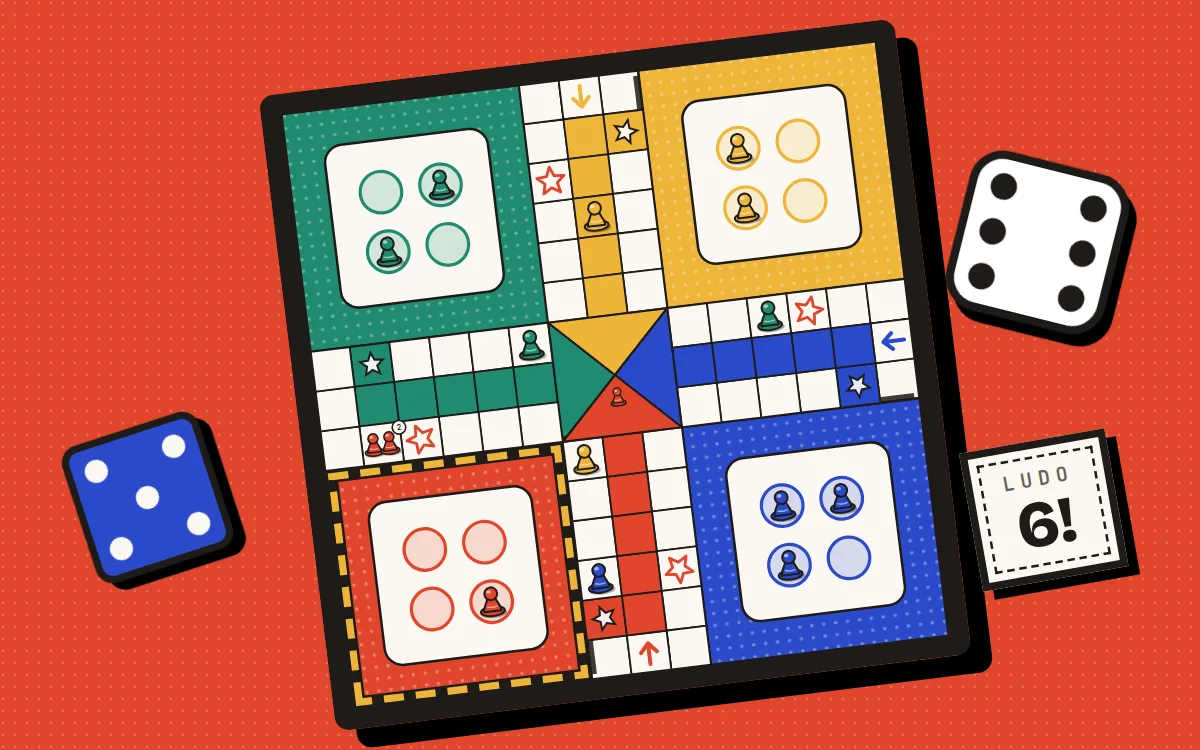
The board is a cross with a ring of 40 squares. Each player has a house in a corner where four pieces wait, a start square on the ring in the colour of the house and a lane of four home squares in the same colour that points from the ring toward the middle of the board. Pieces travel clockwise. A piece that leaves the house lands on its own start square, goes all the way round the ring and, instead of passing its start square a second time, turns into its own home lane.
The goal is to fill all four home squares with your four pieces. Because the lane is only four squares long and every piece needs an exact count to enter, the finish is the most tense part of the game. Nothing is shared in the home lane: opponents cannot enter yours and cannot capture there.
Getting out of the house: the 6 and the three tries
You need a 6 to bring a piece out. It is placed on your start square and, because every 6 gives another roll, you roll again immediately. If you roll a 6 while you have no piece left in the house, you simply move a piece on the board by six and then roll again, so a 6 is never wasted.
When all four of your pieces are in the house you do not have to wait a full round for each 6. You roll up to three times in a row, and the turn passes only after the third miss. The same applies when your pieces are packed at the far end of your home lane and none of them can move, which looks to everybody else like having nothing to play. As soon as you have a piece on the board that can move, you roll only once per turn. Some families play one roll per turn throughout, so our house rules let you switch the three tries off.
Tip
With a piece on the board, a miss is not a wasted turn: you still move that piece. The three tries only matter when you have nothing else to do.
The compulsory moves, in order
Mensch ärgere dich nicht has a short list of moves you are forced to make, and the order matters because more than one can apply to the same roll. We check them in this order.
- Clear your start square. If a piece of yours stands on your start square while you still have pieces in the house, that piece must move first. Otherwise nobody could come out. If it cannot move because it would land on another of your pieces, this rule is skipped.
- Leave the house on a 6. A 6, a piece in the house and a free start square mean you must bring a piece out. Moving another piece with the 6 is not allowed.
- Capture when you can. If any legal move ends on an opponent's piece, you must choose one of the capturing moves. This is the Schlagzwang that gives the game its character.
- Otherwise, any legal move is yours to choose.
Capturing and the absence of safe squares
To capture, move a piece so that it ends exactly on a square holding an opponent's piece. The opponent's piece goes back to its house and yours takes the square. You may jump over any number of pieces on the way, yours or theirs, because there are no blockades. You may not end your move on a square that holds one of your own pieces.
No square is safe. The start squares are not safe either, and a piece that leaves the house with a 6 captures an opponent standing on your start square. In many families this is the rule that leads to the loudest arguments, because a piece waiting on someone else's start square is a clear target. There is also no bonus roll for capturing in the standard rules, so a capture costs your opponent time but does not give you a turn.
The home lane and the exact count
After a full lap, a piece enters your home lane. It needs an exact count: a piece standing on the last ring square before the lane can use a 1 to reach the first home square, a 4 to reach the deepest one, and no number above four. A roll that would take the piece beyond the end of the lane cannot be used by that piece. Pieces inside the lane may keep moving forward into free squares, but they may not jump over one of your own pieces.
Because of this, the order in which you fill the lane matters. If your first piece stops on the first home square, the pieces behind it can only reach the squares beyond it with a jump, which is not allowed, so they are stuck until the front piece moves up. The sensible habit is to move the first piece to the deepest square whenever the roll allows it, and to use small numbers to shuffle pieces forward inside the lane when you have nothing better to do.
Strategy: how to win Mensch ärgere dich nicht
Luck decides a lot, but not everything. The most important idea is distance. With no safe squares, a piece is in danger from every opponent piece that stands one to six squares behind it, with roughly a one in six chance per opponent piece each turn. Before you move, count the enemies behind each of your pieces and prefer the move that leaves the fewest pieces in range, especially the ones that have travelled furthest.
Second, use the compulsory capture. If an opponent has only one capturing move, you can predict where their piece will land. A piece of yours left in range acts as bait: when they take it, their piece lands on a square you may be able to hit with your next move, and the exchange costs you a piece that was still near home and costs them one that was far on the ring.
Third, manage your start square. Leave a piece on it too long and you are forced to move it at a bad moment. Get your first pieces out early when you have the 6s, because late in the game you may need your three tries more than you need a safe-looking position. Finally, begin the final approach early: the exact count means that a last piece waiting on the ring may need several turns.
Tip
In the endgame, count how many squares your last piece needs and which numbers fit. Waiting a turn with another piece is sometimes better than running past the lane entrance.
Common mistakes and house rules
The most common mistake is forgetting the compulsory order and using a 6 to move a piece on the ring while a piece is stuck on the start square. Another is believing the start squares are safe, which they are in Ludo but not here. A third is jumping over your own piece inside the home lane, which many boards allow in casual play but the standard rules forbid.
House rules vary, and our game lets you switch the main ones: three tries, clearing the start square, leaving on a 6 and capturing as compulsory or free, playing for places or ending at the first winner, who starts and a turn timer. To see how the other family games compare, read Ludo vs Mensch ärgere dich nicht vs Parchís vs Petits chevaux, the Ludo rules and our Ludo strategy guide.
Playing Mensch ärgere dich nicht online
To play against the computer choose Easy, Smart or Hard. Easy picks mostly at random, Smart scores each move for captures, danger and progress, and Hard also looks at what the next player could roll after your move. Empty seats are always filled by the computer, so a game with two people at the table still has four colours.
To play with friends press Invite friends, send the link on WhatsApp or copy it, and wait for everyone in the lobby. Up to three friends can join without installing anything, and chat and voice chat are available during the game. You can also search for a table with other players using quick match. Everything runs in your browser on phones, tablets and computers, and nothing needs to be downloaded.
Questions people ask
- Do you have to capture in Mensch ärgere dich nicht?
- In the usual German rules, yes. If any of your legal moves ends on an opponent's piece you must make one of those moves, which is called Schlagzwang. Our game applies it by default and you can switch it off in the house rules. The compulsory moves are checked in a fixed order: clear your start square, leave the house on a 6, then capture.
- How many rolls do you get to throw a 6?
- Up to three per turn when every piece is in the house, or parked at the back of your home lane and unable to move. After the third miss the turn passes. As soon as a piece is on the board you roll once per turn, plus another roll after each 6. The three tries can be turned off in the house rules.
- Are there safe squares in Mensch ärgere dich nicht?
- No. No square on the ring is safe, including your own start square, and a piece coming out of the house captures an opponent standing on your start. Protection comes only from distance, so keep your pieces out of the six squares in front of opponents' pieces whenever you can.
- How do you enter the home squares?
- With an exact count. After a full lap a piece turns into your lane of four home squares, and a roll that would carry it beyond the last square cannot be used by that piece. Pieces inside can still step forward into free squares, but they cannot jump over your own pieces. You win by filling all four home squares.